
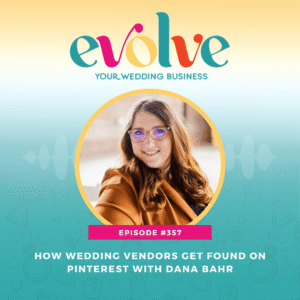
How Wedding Vendors Get Found On Pinterest With Dana Bahr
Most wedding pros either ignore Pinterest completely or treat it like Instagram and wonder why nothing happens. Pretty pictures. No context. No clicks. No inquiries.
Here’s the thing nobody tells you: Pinterest isn’t social media. It’s a search engine. And couples are using it heavily during the research phase, way before they’re ready to book anyone. By the time they reach out to you, they’ve already spent 7 to 12 hours consuming content related to your service. Pinterest is where a huge chunk of that happens.
That means if you’re not showing up there with content that actually answers what couples are searching for, you’re invisible during the most important part of their decision-making process.
In this episode, Pinterest strategist Dana Bahr breaks down her VEIL method and exactly how wedding pros can use Pinterest to get found, build trust, and generate leads without creating a mountain of new content from scratch.
In this episode we’ll cover:
- Why Pinterest is a search engine, not a social media platform, and why that changes everything about how you use it
- What the VEIL method is and how each piece works together to turn Pinterest into a lead-generating asset
- Why couples trust their own search results more than your follower count or reviews, and what that means for your marketing
- How to get a month’s worth of Pinterest content out of a single wedding, blog post, or podcast episode
- The pot roast analogy that perfectly explains why beautiful images alone aren’t getting you clicks
- What “evergreen content” actually looks like in practice and why it’s the only marketing that works for you during your busiest seasons
- How smaller wedding businesses can compete with bigger brands on Pinterest because it rewards relevance, not popularity
About Dana Bahr
Dana Bahr is a Pinterest marketing strategist and the creator of The Styled Pin Collection, a monthly resource that helps creative entrepreneurs grow their visibility using strategic, on-brand Pinterest content without the constant pressure to show up daily on social media. With a background in both wedding industry marketing and content strategy, Dana specializes in helping service-based business owners turn their offers into evergreen traffic and lead-generation machines using Pinterest as a visual search engine. Her approach focuses on sustainability, simplicity, and showing up in ways that feel aligned, not exhausting. Through templates, training, and her podcast The Unapologetic Pinner, Dana empowers entrepreneurs to create a marketing presence that works while they rest.
Website: ddvirtualmanagement.com
Instagram: @danas.desk.nc
Links & Resources:
The Wedding Business Collective
Wedding Pros: How to Generate Evergreen Leads & Book More Weddings With Dana Johnson
Want more? To subscribe to the podcast, please use the links below and be sure to leave a review:
Click here to subscribe via iTunes/Apple Podcasts (You’ll just need to click the blue “View In iTunes” button and then click the Subscribe button when your iTunes opens.)
Click here to subscribe via Spotify
Click here to subscribe in any other podcast player
And please take 2 minutes to leave me an honest rating and review on iTunes by clicking here. It will help the show and its ranking immensely! Thank you – I appreciate it!
Still Paying for The Knot or WeddingWire (Because You Don't Have A Plan B)?
So many wedding pros have told me they're not seeing the results they used to from directories.
Discover the proven roadmap wedding pros use to stop depending on directories and finally attract inquiries that lead to bookings.
Transcript: How Wedding Vendors Get Found On Pinterest With Dana Bahr
Heidi Thompson:
Pinterest is huge with couples, but are you tapping into it for your marketing? In this episode, we’re going to break down how you can.
Heidi Thompson:
Hey there, welcome to the Evolve Your Wedding Business podcast. I am your host, Heidi Thompson, and today we’re talking about Pinterest. Pinterest is interesting because it’s so huge with couples, and yet A lot of wedding pros don’t tap into it for their marketing. I think maybe because they find it overwhelming or they’re not really quite sure, you know, what to do there because it is different. Pinterest got kind of lumped in with social media and I, yeah, there’s a social component to it, but it’s a search engine and that’s really where the power lies. Also in the fact that the things that you post today can still be found months and years in the future, as opposed to so many of the things we put out on social media that just kind of die like a week or so, quite frankly. So today I wanted to bring on Dana Barr. She is a Pinterest strategist for Wedding Pros, and she’s breaking down her VAIL method, which is a framework for making sure that your content is actually findable during that research process where where couples are super active on Pinterest. So let’s get to the interview with Dana.
Heidi Thompson:
Today I’m joined by Dana Barr, and she is here to talk about Pinterest, which I’m really excited about. It’s actually something I haven’t even mentioned this to Dana, but something I’ve been looking into more lately, just seeing all of trends and just the sheer power that Pinterest has in so many industries, especially the wedding industry. So Dana, thank you for being here.
Dana Bahr:
But so excited to be back.
Heidi Thompson:
So I know you have specialized in Pinterest for a while now, and you— I’m sure you’ve been learning just like tons and tons and tons through that process of, you know, teaching people, helping people how to do this. For themselves. And I know there’s a framework that you’ve developed.
Heidi Thompson:
Can you tell me a little bit about it?
Dana Bahr:
Yes, so it’s something that I created through a lot of trial and error, um, but it really helped me get a better foundation within my own content ecosystem to attract clients so I could work smarter and not harder. The, you know, proverbial every entrepreneur wants to do this. And then I started implementing it when I was approaching client work as well, when I was just a virtual assistant and like helping them map out content to put on other social media platforms. And it’s called the VAIL method, and it stands for visibility. So are ideal clients finding you before they’re ready to book? Evergreen— is your content still working weeks or months later? And that’s And my favorite part of the whole framework is the longevity of it. Um, intentional— does your content match how people actually search and decide? And then leads— is your visibility connected to inquiries and revenue, or is it just spaghetti on the wall and hoping something sticks and you get that one random unicorn client?
Heidi Thompson:
I’m so glad you brought that up because For so many people, it is just spaghetti at the wall, and I’m sure you’ve seen that a lot with, you know, your Pinterest clients. It’s like we just get on this hamster wheel feeling like we have to create stuff, and then we wind up creating stuff for the sake of creating stuff. And is it actually getting results? Sometimes yes, sometimes no, right?
Dana Bahr:
Yes. I have been seeing a shift even on Instagram where Like social media managers that I adore and follow and eat up every single thing that they say to do are reflecting, stop looking at vanity metrics and start looking at metrics that actually matter. And that’s how many
Dana Bahr:
bookings are you getting? Because a lot of people, no matter the platform, are almost like silent lurkers. So they may not like your— they may not heart it, save it, nothing, but they’re watching, they’re seeing it, and then they’re going to book you. Real life example, I just booked a client at the end of last year almost sight unseen because of the content that I have been— I had been posting. She signed a contract without doing a discovery call or anything. She just emailed me, asked me essentially my pricing. I shot it back to her, and she signed the contract without ever hopping on a call. And when I finally got to ask her, she said it was because she searched for Pinterest marketing for wedding pros in some unparticular order, and that’s how she found me, dove into my stuff, and reached out.
Heidi Thompson:
I think that’s It’s something that’s always existed, but I think we’re seeing more of it. And I’ve seen more and more data around, you know, like Gen Z couples spending so much time in the creeper mode, right?
Dana Bahr:
Like the lurker.
Heidi Thompson:
You’re researching, you’re watching, you’re listening, you’re taking it in, you’re getting a feel for this person. And what I’ve definitely seen is when people are ready to book, they are ready. Like, they’re— they’ve done their homework. They are more than ready to go. They don’t really need to be sold as much as we’ve seen in the past. And I think, you know, this is definitely showing up across social media as well.
Dana Bahr:
Typically, by the time someone reaches out to you, they’ve already ingested or consumed 7 to 12 hours of your content or content related to the service that you provide. Gen Z is not searching the way that millennials do, and I am a millennial and I feel very geriatric when I say all of these things, but they’re searching visually, they’re very intentional, and they’re starting much earlier in the planning process. And Pinterest is right in the center of that shift because it’s not just another platform, it’s where that visibility gap is obvious.
Heidi Thompson:
That’s so interesting to me because we— I feel like it’s kind of like an iceberg. Like, what we see is just this little tip above the water that is the inquiry, that is, you know, like what they’re telling you.
Heidi Thompson:
But there’s so much happening below the surface and how people are searching and following and researching and ingesting this information.
Heidi Thompson:
And I’m seeing people be, you know, more decisive than ever by the time they’re ready to reach out. But there’s all that like bottom, you know, 3/4, 4/5 of the iceberg that we have to make sure exists so they can even find it. So that’s where, you know, the visibility piece comes in, right?
Dana Bahr:
Oh, absolutely. And like that trust They’re the demographic, and honestly, I don’t think this is just a Gen Z thing. I think this is just where it’s put your money where your mouth is, is they trust this, their own search, more than social proof. So follower count is going to matter less than how much clarity you provide when they have a problem and they go searching for solutions. They assume— we all just assume good businesses are findable, but when they click on your link to your service page or your blog post or your gallery? Does it all match? Is it all cohesive? Does it all sound like the same person? Does it look like your Instagram? Because they’re gonna look at your Instagram or other social platforms, but they’re gonna dive into more content on your wedding site as opposed to anywhere else, because that’s where your personality really gets to shine through your written content.
Heidi Thompson:
It’s funny because that is a good point. I’m just even thinking about, you know, as you’re talking through that, how I search for things, how I look at things, how I investigate.
Heidi Thompson:
And even when, you know, we find positive social proof, it’s kind of like, yeah, I’ll see about that.
Heidi Thompson:
Yeah, I’ll go find out for myself.
Dana Bahr:
Exactly. Well, and like, too often we hear or can— well, not hear, but I guess find others who are, you know, they’re just asking their friends and family, hey, leave me a Google review, because it does help you rank, which is great. That’s talking about your personality and a good vibe check. But you didn’t plan their wedding. Well, you may have planned their wedding, but most likely you didn’t plan their wedding. So people are looking for a more personal
Dana Bahr:
like look into their market research, which gives smaller wedding businesses and the ability to compete with bigger brands because Pinterest isn’t going to reward popularity in that sense. It’s going to reward relevance. So the more you can connect with your audience on that relevant, intentional level, the more this platform is going to push your content out because you have been trusted by millions of users.
Heidi Thompson:
That’s so interesting and such a good point. Like you said, this levels the playing field so much.
Heidi Thompson:
So take me through—
Heidi Thompson:
let’s start with the V. Take me through visibility.
Heidi Thompson:
What do we mean by that? What does that look like?
Dana Bahr:
So visibility is It’s— well, visibility is the market research. It shows you— you need to do like the pre-planning, almost like the SEO. What are people actually searching for? When are they searching? And will your content actually answer those questions? So if your content doesn’t show up in any of those places, it’s not a posting problem, it’s a visibility problem. So visibility first starts with setting the foundation of are they able to find you before they’re ready to book? Because that’s the sweet spot. That’s the funnel filler with does your content even answer questions they may not even know they have, other than I’m planning a wedding, I’m getting married, now what? There’s a thousand questions that probably thousands of questions that people are going to search for right when they get engaged. So figuring out what are the keywords and search terms that they’re looking for, and then creating content that will help boost your visibility organically as they’re searching.
Heidi Thompson:
I love your way of thinking about this more like SEO because Pinterest is such a weird platform. I feel like it for a long time tried to— or maybe we just classified it wrong as like social media, But it is so search heavy and thinking about, okay, I am my ideal client. What am I searching for? Sure, I might be searching for wedding planner and the given location, but there’s also a million other things that I’m searching for that I want to find some information on that you could create content, content, you could create pins to be able to get in front of that person. When they are in that really like that research, figuring out what they don’t know, how does this whole thing work sort of stage. Correct.
Dana Bahr:
So on Pinterest specifically, visibility is going to show up as: are your pins matching what people are searching, which I kind of already covered? Do your boards make sense to the buyer or the couple? Do you show up for planning questions, not just those beautiful portfolio images? Because yes, we want to showcase our work, but we want our work to speak directly to those questions, to pique interest and help them in their research, you know?
Heidi Thompson:
Right. So they’re not just looking for pretty pictures, which I think is what we think of a lot of times when it comes to Pinterest, right?
It’s like they’re actually trying to find information or a solution or something to help them move forward. And I love this because you’re not having to change what the person is doing. You’re meeting them where they are. You’re not trying to, like, engineer their behavior in any sort of way. You’re just looking at their behavior and saying, Okay, I’ll just go stand right in front of this person that I want to meet.
Dana Bahr:
Literally with a sign.
Heidi Thompson:
Yeah, like, hi, I can help.
Dana Bahr:
Well, and that’s— this comes directly from Pinterest account managers that I’ve connected with over the years. Like, if you’re just pinning an image, it— I mean, it’s beautiful and it may stop a scroll in the sense of, oh, they want to look at it, but it doesn’t tell them anything. And that’s where the— that’s the visibility gap or the visual gap. So I’ll use— I’m going to use a recipe. So it’s like a pot roast, right? You post the image of this beautifully plated pot roast, but what is that pot roast? Is that a quick 30-minute meal? Is that a, you know, meal prepped
Dana Bahr:
for busy moms? Is that a station for an outdoor wedding?
Heidi Thompson:
Like, what are we looking at? You have to have that— those keywords on your pin, which is like a little banner telling people what it is that they’re looking at and answering it right then. That’s what gets them to stop, click, and open the pin, and then click through to the gallery or the blog post or your lead magnet or podcast episode or whatever it is that you’re talking about, that food or that item in the picture.
I like that you break it down into those two pieces, right?
Heidi Thompson:
So you’re trying to first get someone to stop, notice it, think, hey, this could help me, and then click it And then, you know, they’re going to read the description and they can go to the page or the blog post or the report, whatever it is from there. But I think if we think about what, what are we actually trying to get someone to do, it can make it a lot easier.
Heidi Thompson:
Yes.
Dana Bahr:
So typically it’s outbound clicks, which is to click through, but the visibility and evergreen components of it. Outbound clicks aren’t going to happen if you can’t be found. So I always start with the foundation of that keyword banks, keyword bank, long, long-tail keywords. What are you actually— who are you actually wanting to attract, and how can we make sure that that happens?
Heidi Thompson:
Um, that’s the nerdy part of it that I do enjoy.
Dana Bahr:
Probably not as much as like Sarah does SEO, but I geek out on all of her content and she just makes me a better SEO nerd when it gets to that process.
Heidi Thompson:
Like, we all need someone like that in our corner because sometimes it’s so hard to see something that someone like you can so obviously see about an outside business. Like, oh, okay, yeah, you need to show up for this, this, this, this. You can do the research, you can find things. I think sometimes when we’re trying to do it in our own business, it’s just like you can’t see, you know, the forest for the trees.
Heidi Thompson:
Exactly.
Heidi Thompson:
So talk to me a bit about the evergreen nature of this, because I think Pinterest is incredibly unique in this way.
Dana Bahr:
So evergreen is where Pinterest becomes like a CEO-level asset in your marketing ecosystem. Is your content still working after you post it? It is no secret to anyone in any industry, but especially in wedding professionals, Instagram stories disappear, reels are going to spike and then they kind of die off. But Pinterest content can drive traffic for months or years if it’s built around what people are constantly searching for. This matters because most wedding pros are busy. We all have those crazy seasons where you have like back-to-back weddings, multiple day weddings, and at that season you don’t need more content.
Heidi Thompson:
You need the content you already have to be doing more for you and to do— be doing the legwork that allows you to, in between events, take a breather and not think, oh, I have to post this. Ugh, I have to schedule this because that’s exhausting and you already won’t want to do it. Just thinking 3 months down the road when you’re looking at your calendar and thinking, I have so many weddings and I can’t do anything about this.
Dana Bahr:
So I always ask, is your work being repurposed into evergreen assets?
Heidi Thompson:
And this can be a variety of things.
Dana Bahr:
Are you turning one wedding into a month of visibility, or are you just posting it on Instagram for that 24-hour spike? And then, are you using blog posts, galleries, venues, and planning tips as long-term entry points into your funnels for lead generation?
Heidi Thompson:
Evergreen is what creates that breathing room, and it’s what allows you to step away without going invisible, which allows you to keep that creative component and actually the passion to stay in the wedding industry in the first place.
Heidi Thompson:
I just got so excited when you said a month of content out of, you know, one wedding.
Tell us a little bit what that looks like for your client. I—
Dana Bahr:
anything that I post, whether it’s a podcast episode, a blog, I’ll even repurpose my reels, gets broken down into smaller
Dana Bahr:
bite-sized pieces, almost like mini elevator pitches for pin titles and descriptions.
Heidi Thompson:
So like one blog post will naturally get about 10 pins, and if I do a podcast episode every week, that’s another 10 pins. So right there, it’s like just on a weekly basis, that’s 30+ pins from 4 podcast episodes.
Dana Bahr:
Set it—
Heidi Thompson:
I can almost set it and forget it. With weekly searches and everything else, and then just move on. So if a kid gets sick, life happens, a hurricane disrupts something, heaven help, another COVID situation— like, I already have content posted out 10, 15, 20, 30 days at a time. I have breathing room to put out fires and not add one more thing to my plate.
That feels so good. I love when you realize that the things that you create can be assets, can be long-term assets, and it doesn’t just have to be this thing you’re just burning through every single day.
Heidi Thompson:
Absolutely. Evergreen content is marketing that truly respects your time no matter what season of life you’re in.
I love this so much. I want to go in so many different directions with that, but For someone who’s like, wait, what are you talking about? How would a single blog post turn into like 10 pins? Could you give us a couple examples?
Dana Bahr:
Um, yeah, so I want to pull it up so I can like really talk about it. So I am actually working on a blog post called Quarterly Business Planning Tools for Lasting Growth. It is not live yet, so do not go look for it. But each section— so it has 1, 2, 3, 4, 6 sections, like with a header and like smaller bite-sized pieces that flow in like paragraph or bullet points. And then I have a key takeaway section.
Heidi Thompson:
So I’m going to take each of these sections and I’m going to break that down into 3 to 5 Pin titles and descriptions. So why—
Dana Bahr:
one of the sections is why quarterly planning matters more than annual goals.
Heidi Thompson:
That will be broke— that’s a pin title in itself.
Dana Bahr:
And then the description will be, for wedding professionals and creative founders especially, quarterly planning supports sustainable growth in seasons where demand, life, and capacity constantly shift.
Heidi Thompson:
And then whatever my call to action is, will be to read the full blog post, dive into your quarterly plans, something to get them to click. That’s just one, and that’s how my brain is going to work when I’m looking at these bigger pieces. What hooks can I pull from it to turn into pin titles and descriptions? And they’re all going to lead to the same blog post.
I think that is a huge mindset shift for people. I remember when I first kind of learned this and discovered how to repurpose content in different ways, and there, once you really start digging into it, it’s, it’s endless.
Dana Bahr:
Well, think about how many images you get back after a wedding. There’s thousands of images that you get. And are you gonna put all 1,000 on your website?
Heidi Thompson:
No.
Dana Bahr:
You’re going to pick like the top 30 to 50, but you can use the variations that are very similar that are still high quality to the ones that are on your web that you did put on your website on Pinterest and funnel them to that gallery where you have endless meta descriptions on these images where you have other vendors tagged or hyperlinked, or hopefully you have them.
Heidi Thompson:
Shout out if you do. If you don’t, you should.
Dana Bahr:
Venture credit.
Heidi Thompson:
But then you’re creating not an ecosystem for your own stuff, but you’re also going to be helping those trusted vendors in your network get visibility as well.
I love that. And that’s such an easy way to think about it. Like, what are all the variations? Even if— I mean, for some of your pins that you create, do they have the same text on them and it’s just a different image?
Dana Bahr:
You can do that. And as if the image is different, it counts as a fresh pin.
Heidi Thompson:
And that’s—
Dana Bahr:
that is probably a whole episode in itself with how easy it is to create what’s quote unquote fresh pin content. So you can have one pin graphic with text overlay and one image. That’s one
Dana Bahr:
that’s one pin graphic. You duplicate that and you change just the image but leave all the text the same. That’s a fresh— that’s a second fresh pin, and all you did was update the image. You can duplicate it again and leave the image of the second one because you refreshed it, but just change the text overlay. And this could be as simple as swapping the— your fonts, your branding assets, that counts as a fresh pin. Like, it’s not— I think too often we overthink it, and I will call myself out, I did this myself with, oh, every single graphic has to be 100% new, and it doesn’t. You’re just creating variations, just like when the photographer is taking photos they have 10 different angles of the same slice of cake. All are beautiful and all have the ability to like just show it just slightly different. It’s a variation, but it’s all— and it’s— they’re all individual images.
Heidi Thompson:
Yeah, I think that makes it so much easier to think about it that way. It’s like you don’t have to come up with something like groundbreakingly new. For every single one.
Dana Bahr:
I think that makes it feel easier. Like, that takes stress off of my shoulders. Like, oh yeah, because on, on social media, you— it has to be a brand new thing, you know? Like, you can’t post the same Reel 3, 4, 5 times and people are going to be, oh, that’s cool. You can post about the same topic, but the Reel itself has to be different.
Heidi Thompson:
Yeah, yeah, that’s definitely different. And Just thinking about it that way, like you could so quickly turn out just easy different variations on the same thing. I love that. So tell me about the intentional piece of your VAIL method.
Dana Bahr:
So intentional is where we stop treating Pinterest like a mood board and start treating it like a buyer journey. Is your content, or does your content match what your ideal client is trying to decide? Pinterest searches are very decision-coded because they’re not just, you know, doom scrolling or mindlessly browsing. They’re actively making decisions and they’re actively searching for something to choose. So Gen Z trends right now are very heavy in like storytelling and aesthetics in the sense of it’s a vibe and like personal details as opposed to— and like guest experience, not, oh, this is what tradition says. They’re not going by the book. They’re searching for cost expectations, what’s worth it when you’re planning a wedding, what aligns with their personal values. So intentional content isn’t just about being the prettiest pin, it’s about setting up clear communication and answering who is this for, what problem does it solve, what should they do next. Because most pins fail because they just— we focus on it just looking beautiful, following from pre— what we were just talking about, and they don’t communicate why it matters or what the next step is for them to take.
Heidi Thompson:
That’s so important and it’s so easy to forget because it’s so easy to get hung up on the visual and like you said, just like the pretty pictures and not realize that, okay, you get someone to look at this picture, but then what are they supposed to do next? And if they don’t have the context for that, they’re probably not going to do anything.
Dana Bahr:
And Pinterest is a platform that rewards clarity, not just creativity, and you definitely need both in your marketing. That’s interesting.
Heidi Thompson:
I think a lot of people might feel like, oh, I can’t get super specific or super intentional, but it sounds like the opposite is actually true.
Dana Bahr:
Absolutely.
Heidi Thompson:
So I’m curious, for your clients, people that you’ve worked with, what does it look like when they go from doing whatever they were doing on Pinterest to being really intentional like this?
Dana Bahr:
So for my clients, I love seeing that almost like light bulb moment, because it’s not always subtle. It shows up in how— mostly it shows up in how their marketing feels and how they as business owners operate from a day-to-day standpoint. So they stop— their content stops trying to do everything. And I will
Dana Bahr:
again, I’ll call myself out. When I first started my journey in entrepreneurship, and even when I was a wedding planner, I tried to do everything for everyone, and that was exhausting. So content is created not because I should, but because it serves a purpose. It’s inviting couples into your world and you are now able to answer specific questions or support a decision. I think too often, especially looking at Gen Z, they’re looking for supportive vendors to like help them express who they are with their guests. And your content can now move someone one step closer to booking for you because you have that why your content is existing, not just ‘Oh, this is pretty. I hope someone likes it.’ Intentional content is speaking directly to the right couple that you like to work with and you know how to support through every step of the process. Um, I think another thing is their marketing strategy gets simpler. They’re not randomly posting. They’re not staying up until midnight trying to put together this gallery or this blog post, or, you know, whatever it is that they’re trying to do, makes a perfect reel montage. They have clear— my clients, usually we get clear categories, content that is aligned with search intent, no matter if it’s on Pinterest or their blog or setting up their gallery on their website, which I treat like a blog post because the amount of metadata descriptions that have to go into each image. Pinterest becomes that decision support tool and not really a dumping ground for, oh, let’s just put it out there and see what happens. It’s mapped out in, in various planning stages of early, mid, and ready to book.
Heidi Thompson:
I love this, and it all comes back to that intentionality of here’s where people are. Here’s what they’re looking for. Let’s just give them what they’re looking for, and then we can hopefully convert them into that last letter, which is lead.
Dana Bahr:
So tell us a bit about this stage. Well, but intentionality doesn’t always mean more leads, which fits— it means better ones. So, and that’s one of the biggest shifts or tells in is your content ecosystem working, because is your visibility connected to increased bookings and overall revenue? Because visibility without leads is just busy work, and we don’t like busy work. We don’t want to be productive without the fruits of our labor. So for wedding businesses, this is where we make sure Pinterest isn’t just sending people randomly to the wrong place or to a place that doesn’t convert. It’s all one, it’s all together and like almost like a web. So the lead part of the VIL looks more like, are pins pointing to the right link? Is it going to the right blog post? Is it going to a service page or a gallery or a lead magnet? Does your website— and I am not a web designer, so don’t come at me, I have referrals for that— but I know enough that your website needs to help them take action once they land there. I have had clients in the past where we had a giant spike in website traffic. I’m talking like 20 to 30 lead— like visits consistently every week from their Pinterest content, but their website didn’t match and they had— it— they weren’t converting. So I was bringing traffic and I was attracting the people, but they weren’t ready to buy because when they got to the website, it looked like two completely different planners. So this is, this is why it’s an ecosystem. It’s not one or the other. It all has to line up in a cohesive way. And this is where Pinterest helps shine because it’s not relying on you being on every day like on social platforms. It’s working in the background, building trust through that repeat exposure. Which then creates those warmer inquiries because they’re— you’re guiding them to your website. And from your blog post, they maybe, once they start scrolling and get like a third or halfway down, there’s a, a popup that’ll come up to share a lead magnet to put them on your email list that still aligns with the same topic of the blog post. And now you’ve naturally created 2 or 3 more touchpoints because you get to email them directly for the next step, which I love.
Heidi Thompson:
I absolutely love email marketing. It is the backbone of my business, but I know not all wedding pros use it. Do most of your clients use email marketing?
Heidi Thompson:
as part of their overall strategy and Pinterest strategy, or are some people, you know, sending people to blog posts or—
Dana Bahr:
Most are sending to the galleries, blog posts, and service pages. I did connect with a wedding planner who we were brainstorming a visibility system that even if the couple didn’t book them for a wedding, they were on their email list. So they were sent— their goal was to send out quarterly emails to catch them on other life events. So baby showers, honeymoons, because they offered travel planning, um, birthday celebrations, anniversaries, anything else that they wanted to celebrate, because they weren’t just wedding planners. And so that was their way of like Keeping connected. Hey, didn’t get to book your— like, you know, miss your wedding, but we’d love to help celebrate. And we would just focus it on like upcoming seasonal things. That’s cool.
Heidi Thompson:
That’s an interesting strategy. And I love that, you know, you guys developed that as this is the strategy. We’re not just going to put random stuff out there. We’re not just going to email to email. We’re not just going to pin to pin. It’s going somewhere.
Dana Bahr:
Absolutely. Leads happen when visibility meets a clear next step. And for them, they were thinking very broad, and I loved it. It was so fun to work with them on that project, and I hope other people want to do it too.
Heidi Thompson:
Seriously, email marketing is so untapped, and it is an absolute goldmine, especially in a world where, you know, all of these different platforms, like, you can’t necessarily reach people when you want to, like, if, if they get shown the content or not.
Dana Bahr:
Absolutely. Well, and then I’ve read a statistic somewhere, and I’m probably going to butcher it, but I think it takes— I don’t think it’s wedding industry specific, but it’s pretty close. It takes 7 to 12 touch points before someone’s comfortable to purchase from you, especially on a higher ticket item. It was mostly for like coaches and consultants, But for wedding professionals, that’s why I really loved building that email marketing for those that like the lost business and circling back around. They’re creating those 7 to 12 touchpoints to essentially almost have repeat business because birthdays happen every year. You know, holiday parties happen every year. And once you get in the door and they book with you, they’re comfortable with you. They’ll book you again and again, and now you have consistent revenue setting a foundation while you also have weddings to spike through the various seasons.
Heidi Thompson:
Gotta love that. I love when we can get like two birds with one stone like that.
Dana Bahr:
Absolutely.
Heidi Thompson:
So for your clients, tell me a little bit about like, what does the after picture look like when someone has a strategy like this? In place? Are they seeing, you know, a certain amount of leads or regular leads coming directly from Pinterest? Are they booking more aligned clients? What does that after look like?
Dana Bahr:
So the after picture is marketing no longer feels loud or urgent, and that’s That’s the best part, is it doesn’t feel urgent. So when a VAIL strategy is in place— and I want to preface that this is not something that goes— happens overnight, and this is not about going viral. This is setting up a foundation, and that organic foundation can take 2 to 3 months to get set up. But once it’s going, it it just consistently compounds and builds momentum. So, but the after— like you were talking about the after picture— when this strategy is in place and you are consistently repurposing your content in a very strategic way, instead of feeling, I should post something, I’ve been quiet, I need to catch up, what if people forget about me? The confidence is con— you know your content is circulating. Your name is being seen, your brand is being seen, your expertise is consistently being reinforced because you are putting it on a platform that is built for discovery and it is a visual search engine. So the visuals that you worked 12 to 18 months on curating for this couple are working constantly in the background quietly, but keeping your visibility front and center. So a lead— leads that arrive are already pre-educated because they’ve already ingested, like, consumed your content. They joined your newsletter list, they read your blog post, they dove into your services, they found your Instagram because you repurposed your reels. And so they don’t— those inquiries aren’t going to start with, well, what do you offer? They already know that. Do you do weddings? They already know that too.
Dana Bahr:
or they wouldn’t be reaching out to you. How much do you charge? That’s probably a moot point because they already feel so connected and love what you’re doing. So they’re going to say, oh, I read your blog about timelines and felt like you really understood what I was looking for, or what we need with our 3-day wedding, or what have you. We’ve been saving your content for months. I can’t wait to work with you. You’re no longer introducing yourself, but you’re being chosen.
Heidi Thompson:
That is a huge shift. Like, because then you put yourself in your own category, really. You’re not competing against everybody else because you’re being viewed in a really distinctly different way. There’s like everyone that I guess could work, and then there’s like the one, right? Like, there’s the person that I know is the perfect fit, and I know I really want to work with, and I already have a feel for what it’s going to be like. And like you said, this is creating an asset that works for you. As you know, when you’re busy, and I’d be curious to know for your clients or, you know, people that maybe you’ve worked with or maybe you’ve just, you know, talked to about this, what is that regular cadence look like? Are they taking chunks of time away from creating content? Are they bulk creating a bunch of stuff in one phase? I’m sure it’s different for everybody, but I’d love to get a peek behind the curtain at that.
Dana Bahr:
So I always recommend starting with one core piece of content, like the bigger thing that your ideal client couples or clients are going to be looking for. Do your ideal clients favor visuals? So then we need to create a gallery that’s more like a storyboard that visually walks them through the entire wedding day, or even the wedding weekend if there’s like events happening beforehand. Um, or do they like long-form content? So we want to make sure we’re spending more time creating a well-optimized blog post and then breaking it down. I say if you’re doing this on your own, my advice is start with just 1 to 2 pins per day. Do not overstress yourself because if it’s stressing you out, it’s not worth it. 100%. And Pinterest is worth it, but don’t feel like you have to approach this and make it feel like one more thing to do when you’re trying to put 5, 10, 15 pins out per day. That’s unrealistic, and you’re going to give up before you have a chance to see that momentum. I have helped wedding planners increase their website traffic by like 60-70% with just the 1 to 2 pins per day. We took the content they already had and repurposed it in a very simple but intentional way, 1 to 2 pins per day every single day, and within 2 to 3 months they were seeing a bump in their website traffic. And it was coming from Pinterest because we put the little pixel in there. Um, but I recommend at least 3 pins per day, 3 to 5.
Heidi Thompson:
And like we said before, those don’t have to be like reinventing the wheel. They can be pieces. Like you said, start with one big piece of content and then look at all the different ways you can break that apart. I think that’s such a smart way of looking at it.
Dana Bahr:
So you can take the, the bigger piece of content and then break it into how to do XYZ, timelines, checklists, testimonials, lists, what, like, you can break it down to a variety of different types of pins for that and points of view.
Heidi Thompson:
And I think we just have to start looking at it a little bit differently as not a one and done, but I know I can get more out of this. What is another angle I could use to talk about this? Or what section even of this blog post have I not highlighted? And maybe I could just highlight that and bring them to the blog post. Like, here’s one of the 5 things that are covered in this blog post. Well, now you have 5 different pins right there. So I think just shifting the way we look at it is going to be really big for people listening.
Dana Bahr:
Absolutely. Well, and then I’m not afraid of using AI tools to help with that, to see something that I can’t see. So I’ll go on Pinterest and websites like Answer the Public or Ubersuggest to see what searches are trending. I will take that information, that data, and put it into platforms like ChatGPT and say, I want to reshare or repurpose this blog post because it has all the long-form detail on
Dana Bahr:
Pinterest using these keywords, how can I create pin titles and descriptions that naturally fill these keywords? And it’ll help me do that, and it’ll show some of it. It’ll spark new ideas that I’ll come up with myself, and I’m like, oh yeah, I didn’t see that, or oh, I didn’t think about that, or it’s helping me repurpose the data in a, a very smart way.
Heidi Thompson:
I love that. And like you said, work smarter, not harder. Let’s try to make this as easy as possible on a Yes. Dana, is there anything else you would want someone who’s thinking about digging into Pinterest as a place to get discovered, a place to get leads, to think about for right now? I’m sure there’s a million things that you can talk about with them, but is there anything else you want them thinking about now?
Dana Bahr:
I think Pinterest makes this framework, the VAIL method, easier because it gives you real-time insight into what your clients are actually searching for. Um, it helps you figure out their search behavior, and that makes it one of the most important assets in your marketing tool belt.
Heidi Thompson:
Yeah, I mean, the fact that you can just go in and kind of just connect dots for people, like, oh, they’re searching for this. Okay, this is what we’re going to create to address that. I’m searching for this other thing. Okay, this is what we have to address that. It’s a much easier way of going about creating content than like trying to dream up every possible idea.
Dana Bahr:
Yes, I use, use it all the time. I love going on there.
Heidi Thompson:
So yeah, I, I need to dig into it more. I really do. I mean, it’s such a powerful tool. It’s— and the fact that weddings are so huge on Pinterest and the fact that you can build an evergreen asset, that is a rare thing in today’s world outside of your own website. I mean, you know, social posts die so fast. But like you said, Pinterest pins can send you traffic year after year, which is huge. Now I’m curious where people should go if they want to catch up with you, if they want to learn more, if they want to put a Pinterest strategy together, if they’re like, oh, okay, I can see how this whole, like, visibility turning into lead thing could kind of work, but how do you actually work with people and where would you like people to go to connect with you?
Dana Bahr:
So if anyone listening has been thinking, oh, I feel like my visibility is scattered, or this sounds amazing, I want my content to work harder and better for me, then I’d love to connect. The best way to find me is through my podcast, The Unapologetic Pinner, or to connect with me on Instagram, which is @danas.desk.nc for North Carolina. Um, if anyone is wanting a CEO-level view of what’s working and what’s not working in their content ecosystem, then on my website they can learn more about the Veil Audit, and it’s designed to give you clarity before you add anything else to your plate.
Heidi Thompson:
I love that you were speaking my language right here. Let’s not add more things on pointlessly because that’s what we’ve been doing for so long.
Dana Bahr:
And it, it never works.
Heidi Thompson:
It doesn’t. And it’s so exhausting. It’s like, oh my God, it’s the worst of both worlds.
Dana Bahr:
Yes. So I would love to help any way, shape, or form, but that’s how I best support.
Heidi Thompson:
Awesome. Well, I will link to all of this in the show notes. You guys will be able to find that in the show notes. I will make sure that we have that Pinterest podcast. You can dig into the whole world of Pinterest with Dana, as well as those other resources. And Dana, thank you so much for being here and breaking this down for us. I appreciate it. Absolutely.
Dana Bahr:
Anytime.
Heidi Thompson:
So what do you think? Is Pinterest something you are going to tap into for your business, or is it not for you, or is it something that you want to tap into later down the road? I would love to hear from you. You can shoot me a DM over on Instagram. I am @evolveyourweddingbusiness, and I will have everything we mentioned in this episode linked up in our show notes over at evolveyourweddingbusiness.com/think. Thank you so much for taking the time to tune in today, and I’ll speak to you again very soon.