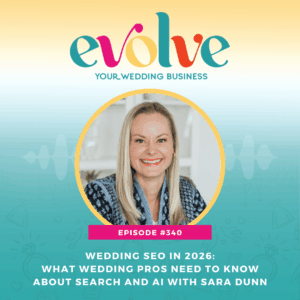
Wedding SEO in 2026: What Wedding Pros Need to Know About Search and AI with Sara Dunn
If wedding SEO feels confusing right now, you are not imagining it. Search is changing fast. AI is changing how couples find vendors and what used to work may not be enough to get you found on Google in 2026.
So what actually matters now when it comes to wedding SEO and how do you get found by more engaged couples?
In this episode, we are digging into what is really happening with search, how AI is influencing search, and what wedding professionals need to understand if they want to stay visible.
We talk about how couples search today, what Google is rewarding now, and why SEO for wedding pros is not just about keywords anymore.
If you want to get found on Google as a wedding vendor, understand how SEO for photographers and other wedding pros is evolving, and make smarter decisions about your website moving forward, this episode will give you clarity.
In this episode we’ll cover:
- Why wedding SEO is changing fast and what actually matters going into 2026
- How search behavior is shifting for wedding pros and what couples are doing before they ever inquire
- Where AI is already influencing wedding vendor search and what that means for your visibility
- The biggest SEO mistakes wedding pros are still making that keep them buried on Google
- What SEO for wedding pros needs to focus on now instead of outdated tactics
- How photographers and other wedding vendors can adapt their content to stay findable
- What getting found on Google really looks like in the next phase of wedding SEO
About Sara Dunn
Sara Dunn is the go-to Wedding SEO expert for planners, photographers, venues, and other wedding pros who want to rank higher on Google without the tech overwhelm. As the founder of Sara Does SEO, she offers done-for-you services, coaching, and courses built on her proven Wedding SEO Framework. A sought-after speaker and educator, Sara’s strategies help over a million searchers connect with wedding professionals each year.
Website: saradoesseo.com
Instagram: @saradoesseo
Links & Resources:
The Wedding Business Collective
Get Sara Dunn’s SEO Bootcamp!
Cocktails & Keywords
Episode 204: 3 Tips for Blogging for SEO (Even if You Hate Writing!) with Sara Dunn
Want more? To subscribe to the podcast, please use the links below and be sure to leave a review:
Click here to subscribe via iTunes/Apple Podcasts (You’ll just need to click the blue “View In iTunes” button and then click the Subscribe button when your iTunes opens.)
Click here to subscribe via Spotify
Click here to subscribe in any other podcast player
And please take 2 minutes to leave me an honest rating and review on iTunes by clicking here. It will help the show and its ranking immensely! Thank you – I appreciate it!
Still Paying for The Knot or WeddingWire (Because You Don't Have A Plan B)?
So many wedding pros have told me they're not seeing the results they used to from directories.
Discover the proven roadmap wedding pros use to stop depending on directories and finally attract inquiries that lead to bookings.
Transcript: Wedding SEO In 2026: What Wedding Pros Need To Know About Search and AI with Sara Dunn
Hello, my friend. Welcome to the podcast. I’m your host, Heidi Thompson, and I’m all about helping wedding pros just like you book more weddings with clients you love. And a big part of doing that is showing up when they’re looking for you. Whether they’re looking in traditional search engines like Google or they’re using AI tools to try to find their vendors, you want to make sure that you get found. That’s why I knew I had to bring the one, the only, Sara Dunn from Sara Does SEO back onto the podcast to talk about what is happening now with SEO and what has changed how people are using AI to search and how you can get found more easily by couples who are a perfect fit for you in 2026 and beyond. So, without any further ado, let’s dive into this interview with Sara. Today I’m joined by returning guest Sara Dunn, the wedding SEO expert who you know and love. And I am so excited to have her here because so much has been happening in the world of SEO. I’m sure you’ve heard so much about how SE was changing, how AI is changing everything else. So, Sara, thank you for being here.
Sara Dunn:
Well, absolutely. I am so excited to dive in with you, and I know you always ask the best questions, so I’m excited to tackle this topic with you.
Heidi Thompson:
So SEO has been, you know, around for quite a long time. There’s always changes. There’s always certain things that pop up that are more or less important in that time. There are a lot of things that are just, like, steady, and we need to make sure we do and stay the same. But I’m curious if you could give us, like, a little bit of an overview of what you’re seeing right now, because you have a pretty unique position.
Sara Dunn:
Ooh, absolutely. So every single day, SEO is what I do. And it’s just for the wedding industry, which allows me to really take a look across wedding planners, photographers, venues all across North America, all across the world, and kind of see what is going on. And just in case anyone is listening to this episode and this is the first time you’ve heard of SEO, I just want to clarify that what we’re talking about and What I do every single day is help wedding professionals get found when engaged couples search online. And for years we’ve really been focused in SEO in helping businesses get found on Google because that was the main search engine, had a huge market share of searches everywhere. And so even though other search engines exist, you know, Yahoo and DuckDuckGo and Bing, we’ve really been focused on Google because they had such a huge attention share in the search market.
So I’ve been doing SEO since like 2011 and Google was where I lived every single day. And it’s certainly still a place where I’m spending a lot of time, something I care a lot about. But this is a time in the world where a lot of search behavior definitely is shifting. And if you follow anything related to marketing online, you’ve probably seen some information about how AI searches are increasing and that people are using their favorite AI tools as search tools, not just things like writing assistance or things you can ask questions after you go to the dentist. Like, people are using tools like ChatGPT actually as a place to search. Heidi, I’m super curious if you actually do this too. I know you’re a ChatGPT user. Do you use it to search for things that you’re looking for?
Heidi Thompson:
I have been using it more and I noticed like even just as we’re recording this, like in the past few weeks, the past month, it getting better and better and more robust.
Sara Dunn:
Yes, I totally agree with that. Because when ChatGPT first rolled out, really the way that it worked was that it just when you asked it a question, all of the information it had was from its own training data. So information that had been fed to ChatGPT over multiple years, but a lot of it was really outdated before we even started using it. So you could ask it a question and it would give you really outdated answers or sometimes they would even make stuff up. And at least in my experience, I’m finding that now they’ve gotten a lot of feedback and that’s happening less and less. I still see some things made up, but when I ask it a direct question like who are the best wedding planners in Austin, Texas, it actually goes out to the Internet and searches through live websites instead of just looking at old training material, which has really improved the quality of what comes back to us as users.
So I think this is something that, yes, people are really definitely going to start trying more. And it’s a really interesting opportunity in my world of SEO to figure out as a business owner, if someone using ChatGPT or another AI tool is looking for exactly what you do. How do you make sure to show up there? And that’s what I’ve been studying a lot more recently, helping my clients get found and recommended through ChatGPT.
Heidi Thompson:
Yeah, tell us a bit about that. Because there are, you know, the best practices of SEO when it comes to your website. And I’m going to refer to all of this as SEO because it is all search. I know there are like the million names people come up with, there’s so.
Sara Dunn:
Many acronyms, it’s awful.
Heidi Thompson:
It’s SEO, it’s fine.
Sara Dunn:
Yes, it’s still search.
Heidi Thompson:
So I’m curious, like how does it differ from what you’ve been teaching people they need to do to get found in Google? Like what do you need to think about when you are looking to get found in these tools like ChatGPT? Perplexity. Any of these AI tools? Yeah.
Sara Dunn:
So like what do we need to do as business owners? Like, what is the new SEO? Here’s what’s crazy is that my clients and students and people that have been doing good traditional SEO for a long time actually found that their websites, their businesses were being recommended by the AI tools even before they started thinking about that as a possibility. So I want everyone to know who’s listening to this, that traditional SEO best practices will actually also help you show up in AI based searches. Because a lot of the things that we always did with SEO, like figuring out what people search for or what phrases they know and making sure those are on your website, that helps an AI search engine just as much as it has helped Google to figure out what you do and connect it with people who are looking for it.
So if anyone has heard the hype that everything has changed with SEO and you need to do a whole different type of thing to get found in these search engines in the wedding industry for sure that’s just not true. Because good traditional SEO practices will also help you show up in these search engines. So I still want everyone to be thinking about what’s the most important keyword you want to get found for in your business? That’s usually your main location plus a phrase that describes your services. So I’m thinking like all inclusive, wedding venue in Raleigh or Michigan, wedding planner or Dallas, wedding photographer. Having that kind of keyword on your website, especially in the homepage SEO title is something that is has been really important to Google for years and is really important to AI search tools too. So don’t throw out traditional SEO. I’m saying, like, let’s do that as our base layer. And then yes, there are a few things that will help you specifically appeal to AI search engines. Does that make sense?
Heidi Thompson:
It does. And I mean, the way I’ve kind of thought about it is Google really pioneered searchability, like being able to find what you’re looking for on the Internet. And it’s crazy to me that there are now people old enough that run businesses that do not remember a time when, like, you couldn’t search for stuff. You had to know what you were looking for. You had to know the URL that you were going to. So Google really built the foundation that, I mean, really, this and everything else that will come after it is built on. It’s not like AI is reinventing the way human beings seek out, you know, a solution. It’s a different medium. Sure. But in figuring out the language, the words, the like, what is this person actually asking me to go find them? It’s very much just built on top of what already exists.
Sara Dunn:
Yeah, I totally agree. And I think that in all of the cases, yes, we’re appealing to a new robot. But also all of good SEO starts with understanding the customer and what are they looking for. And that hasn’t necessarily changed just because they’re searching in a different place. They. There’s still certain phrases they know and don’t know. You know, as much as wedding planners want to get found for private estate wedding planner, that’s just not something that engaged couples say as part of their everyday language. So we still have to get familiar with what people are asking their search tools for and make sure that those phrases are associated with your business. So it’s probably a particular location plus a service type phrase. Now I will say searches on AI search tools can be somewhat different. And that’s because Google for a long time kind of pigeonholed us into that little tiny search box. Right? It fit like five words. And so most people for years have searched for really simple things.
The things that I mentioned a moment ago, like Michigan wedding planner, location plus keyword. And that was really all the search engines could understand. The more complex we made it kind of, they would freeze up and be like. And you’d get all sorts of junk back. So you couldn’t go too crazy with your search phrase if you really wanted the search engine to understand what you were looking for. Today though, with an AI search people can actually be very detailed. So I actually had a wedding photographer student in my SEO program. She came into our course community and she posted and she said, I had a bride find me on ChatGPT, and I asked her what she searched for, and she sent me a whole list of criteria. It was like what city her wedding venue was in, how many reviews she wanted that photographer to have, what kind of vibe, Someone who makes me feel good in front of the camera. And then she like gave it it’s her wedding date and was trying to have it help find vendors available on her date. So just from that example, we can see that people want to be able to search in a more complex and kind of like nuanced way. And while the AI tools aren’t perfect at actually meeting all of those criteria, they are able to do multiple searches and figure out which vendors might be the best fit for a really big list. A really complicated question that’s being asked and that’s very different from the way people used to search and the way they are searching with AI tools and may search in the future.
Heidi Thompson:
I just did this myself a couple of weeks ago. So I have this super annoying problem that happens because I have this amazing memory foam mattress, but it’s not as thick as a lot of like pillow top mattresses. So there’s a lot of fitted sheets that are like flappy and like way too big. So I just voice chatted to chat and I’m like, okay, this is what’s happening. This is the brand of mattress I have. This is the size of mattress I have. This is what I’m seeing happen. I measured it. It’s this tall. So I need to figure out like, what is the pocket depth of the sheet. And once it helped me figure that out, I was like, go find me some, because I am so sick of ordering sheets that are too big for my mattress.
Sara Dunn:
And it worked. It worked, it worked. That’s incredible. You know what’s so specific?
Heidi Thompson:
You can’t filter that. Unlike Amazon. Like, oh, okay. I have a foam mattress. So I don’t have the topper thing that comes on pillow topper mattresses. And. And it’s a. I need a 12 inch pocket instead of a 15. Like, that’s not. That’s not information that’s available in filters on any website.
Sara Dunn:
Oh, that. Okay, so I’m.
Heidi Thompson:
But it’s in the product description and that’s where ChatGPT went and pulled stuff.
Sara Dunn:
Okay, this makes sense. So I actually have the same problem. I have one of those smart mattresses and it like tracks your sleep and stuff, but it is not as tall as a traditional mattress. So I had the same problem and I went about it differently. And what I’m Noticing. So what I did was I went to Google and I typed in custom sized fitted sheets and looked for a company that could actually custom make a fitted sheet for my stupid mattress. And what I’m, what I’m seeing in contrast between our approach is you went to your tool with a problem and I went to the tool with my idea of a solution. And you know, you were like, okay, help me figure out what the solution is. And I was like, I think my solution must be a custom fitted sheet. And I went in that direction. But let’s think about that. Like, what happens if more people take their wedding planning problems to a search tool and they’re actually able to discover more services that they didn’t even know existed? Hey, I want my dog in my wedding ceremony, but I don’t know what to do with my dog when I’m actually like, during the ceremony. And what if the chat tool would be like, you should hire a professional wedding pet attendant. And the searcher could be like, I didn’t even know that existed. So how do we get solutions into the tools and really explain them in a better way so that anyone who’s problem awareness can get the solution we want? I feel like that’s the next level I’m excited to explore.
Heidi Thompson:
That is so interesting and I’m so glad you just noticed that because that opens up a world of opportunity for us. I feel like, especially in the wedding industry, we are in a very problem aware kind of industry. We have people who are doing this for the first time. They don’t know what the hell they’re doing. They’re trying to figure it out. They’re doing a ton of research. They’re not super sure what their steps should be other than like they have this list of people they know that they need to hire. But finding them is a completely different story.
Sara Dunn:
Yes. And bringing all together with a budget. So I think when we’re thinking about all of these different things that our ideal clients might be looking for, I think it’s important to remember that this all comes back to the information that we as business owners put onto the Internet for the AI tools to use. And so we’ve talked for a long time in SEO about content marketing. So creating things like blog posts or informational posts or pages on your website so that search tools get a better idea of your experience, they potentially rank you for more searches. And I think this is a great example of how that’s not going away. We need this information out there. If we want AI tools to actually recommend our Businesses, we have to give them more information, not less. We need to lean in to optimizing our websites and putting helpful information on them that can guide people to our services. So I am going to say this out loud, and people are going to slam their phone on their desk when they hear this. But blogging is not dead. It’s still really important if you want to get recommended in all the places and get recommended for more things.
Heidi Thompson:
And it’s super important because when you think about the way we’ve just been talking about this, what your blog posts allow you to do is target a very specific question or problem or something someone is searching for and present yourself as the solution. I think a lot of times from, you know, the business owner perspective, we view blogging as like, oh, this annoying thing we have to do and we have to write, and it’s super annoying. But if you think about it as like, it’s another point of connection you can put out there as, okay, if people are searching for this, I want them to find this blog post which is going to lead them to me. It’s like leading like breadcrumbs.
Sara Dunn:
Yes. And I want to give a concrete example of one of my favorite ways that we do this in our SEO practice. So a lot of people think about SEO and they think about just being found for their own service. And that’s what I’ve talked about already in this episode. So I get it. You know, they come to me and they’re like, Sara, I want to get found for Nashville Wedding Planner. I’m like, I love that. It’s a great idea. Could bring you a lot of business. Let’s work on that. And let’s also consider the other things your favorite clients might be searching for in their planning process. And so one of the things that we discover that a lot of people want to get found for is they love to get found when people are searching for their favorite venues. So, you know, we all have that venue we love. Maybe it’s Greencrest Manor. And you’re like, I worked at Greencrest once. I want to work there all the time. I want people to see my photography or my planning or my florals, whatever it is. I want to get found when people are looking for this venue. And it’s a great strategy because if people are looking for certain venues, it helps you to connect potentially with the right couples. Right.
So they might have a certain budget level, they have a certain style. If they love this venue, they’re near you. They’re not across the world. So we Love helping our clients and students get found. When people are searching for venues where they’re an expert. And that is where blogging comes in. Not just with traditional SEO, but also, this is my hunch and something I have no proof of. But I do think that couples are probably going to say, hey, I want a wedding photographer who has experience at Greencrest Manor, or show me photography from a wedding planner at this budget level or a wedding photographer at this budget level that’s worked at Greencrest Manor before. And so the best way I found in my testing to get a certain vendor to show up when a venue is mentioned is to have a blog post about that venue on their website. You can’t just be like, I’m the best Michigan wedding photographer and hope that you’re going to show up. If people mention a specific venue, you’ve got to put information on your website that proves you’re an expert there. And that’s another reason that blogging is really important.
Heidi Thompson:
I have seen this time and time again with clients of mine that really are focusing on blogging and SEO. But that venue focus is so helpful for them. Getting found earlier in the journey and standing out because, okay, everybody else is being found for, you know, southwest Michigan wedding photographer, but you’re being found for having worked at this specific venue. That puts you in a different category in the mind of the customer.
Sara Dunn:
Yeah, I agree. I even had a wedding planner client who said that she booked a couple because they had heard about her from a referral, but actually landed on her website and she had a blog post all about their venue on her website. It was a venue spotlight. It really showed her expertise there. And they were like, we love that you worked there. We loved reading this blog post. We can tell you’re an expert in it. And that’s. That’s how she stood out and that’s why she got the booking. So this even benefits you beyond search. If people are coming to you in different ways and they can see that you are an expert in something they care about.
Heidi Thompson:
Yeah, it really does help you move people along the sales process. Because something I know I’ve been talking about so much this year is like, trust is so incredibly important. And this is a way to build trust, to build credibility as well as be found. And it’s rare that, you know, we can have one thing that does so many things for us.
Sara Dunn:
Yes. So sorry, everyone. You wanted your permission slip to get out of blogging, and I do not have that for you yet. I still really believe in it as a strategy.
Heidi Thompson:
Is there any content that you’re seeing work really well specifically for AI search? And just to give you some context, I have been reading a lot about how FAQ type content can perform quite well because the person is asking a question of their AI tool and you are literally asking and answering that question in FAQ style content.
Sara Dunn:
Yes. So we’ve been doing a lot with incorporating FAQs, but not exactly in a blog post context. Not that that can’t work, but what I really like doing with FAQs is actually adding them to relevant service pages. So let’s say you’re a photographer and you have a gallery page that’s all about your engagement photography. A lot of photographers are just going to make a gallery page with no text on it and it’s just going to have 100 images and that’s it. Which really isn’t that effective for SEO because you’re not giving these search engines any information about what you know about engagement photography. Where do you do engagement photography? What seasons do you offer it in? Is there a starting price you can share? That is the type of thing that we’ve been adding into FAQ style content on that particular page, even at the bottom, because then the AI search engines can actually read through. And let’s say someone says to ChatGPT, I want to do engagement photos on the north fork of Long island, maybe at these two locations. If you have a page that says that’s exactly where you do engagement photography with a few of your favorite locations in the FAQs, that can actually help you to show up when someone is looking for an engagement photographer. So having the text in the FAQs that explain your service that people ask often really can help you show up more in those searches. So I love actually putting those on the service page itself.
Heidi Thompson:
That’s a great idea and a great way to add additional context to someone who’s already on the page. And it does double duty of helping you get found, which is amazing.
Sara Dunn:
Yes.
Heidi Thompson:
I’m curious, with AI entering the scene in a much bigger way this year, where are you seeing people go off the rails? What mistakes are you seeing people make?
Sara Dunn:
I think the number one mistake is assuming that everyone has moved to AI search tools and spending all of your time worrying about that. I find it really interesting when people come into my inbox and they’re like, can we hire you just for ChatGPT optimization? Like, we don’t want traditional SEO or we think where SEO is fine, but can we hire you just for chatgpt? And my Answer is no. Because traditional search engines like Google are still actually driving the majority of traffic. And I want to make sure that your basics, your base layer is in place before we sprinkle on a few extra things that we do specifically for ChatGPT. So to prove this point, I actually was looking through a lot of client data last month in Google Analytics, looking at overall sources of traffic for wedding industry websites. And I can tell you that for our clients, Google is still driving 70 to 80% of their website traffic on average. And I didn’t see a Single website where ChatGPT drove more than 4%. That was the very highest. It was usually about 1% of traffic. So we think about a wedding planner site I was looking at that got 30,000 visits, they only got 300 visits from ChatGPT and tens of thousands from Google. So I don’t want everyone to throw out Google and traditional SEO as if it’s the past just because AI search engine optimization feels new and shiny and exciting because it really takes both if you want to drive the most qualified leads to your website.
Heidi Thompson:
It’s so funny because it’s just that tendency we all have to gravitate to the new shiny thing and think like, this is it. And we see the language around it like, oh, search is dead, SEO’s dead, everything’s dead, email’s dead, it’s all dead. And this is where we need to focus. And that is almost never the case.
Sara Dunn:
Right. I think we all have seen those kind of especially TikToks and short form video where if you say blah, blah, blah is dead, it gets people’s attention and gets them to keep watching. So if one of those comes across your feed, just know this is someone trying to grab attention. It’s not necessarily advice that’s based on the real data of what’s happening behind the scenes. And so be really careful about anything being declared dead because things don’t shift that fast. They still certainly may continue to shift, but we’re not at a place in the wedding industry today where you’re going to get a majority of your leads from ChatGPT. It’s just not going to happen yet. It’s a great thing for some bonus leads and to get found by people that are very qualified. But it can’t be your whole strategy.
Heidi Thompson:
Yeah, sorry. But actually, no, not sorry, because I think if we, if we have this tendency to jump from new thing to new thing, it’s like we never get the foundational stuff, like the stuff that actually works, taken care of. So I’M going to disagree with myself there. I love it.
Sara Dunn:
I love it. Heidi, I think we should talk about some of the little things we’ve been experimenting with to get websites to show up more often in chat GPT because as I said, you know, we do do our traditional SEO to set the foundation in place. But of course, I’ve been experimenting with what are small changes that seem to help some businesses get recommended over others. I’ve got a few ideas I’d love to share.
Heidi Thompson:
Absolutely.
Sara Dunn:
Okay, so one thing that I’ve noticed a lot is that when you ask ChatGPT about a certain wedding service, like who are the best wedding planners in San Antonio? It will usually come back with a whole table or at least a list of a few options. And one thing I’ve noticed consistently is that chat loves to highlight how much experience a company has. My personal guess is that the tool is trying to help the user to choose between one or the other. And it’s like, well, experience is something that people seem really invested in, so let’s talk about it. And so they’ll say things like, hey, this photographer has photographed 100 weddings. Or this planner has been in business since 2012. And so consistently I see chat cite some measure of experience, and because of that, I’ve really been recommending for all of my SEO clients and students to make it really clear on your home or about page how much experience you have. Of course, this is if you do have a lot of experience. It’s probably something I would avoid if you don’t. But if you’ve been in the wedding industry for a while, I want to see you clearly state in text either when your business started or how many years you’ve been in business or how many weddings or clients you’ve worked with. Give Chad GBT something it can cite to recommend your business above others.
Heidi Thompson:
That’s so interesting. And I can see why it would value experience because it sees us valuing experience. But that’s really interesting that you’re seeing that consistently coming up.
Sara Dunn:
Yes, absolutely. And you know, it’s something that may change over time. The weirdest thing about ChatGPT is it seems to just shift in its mood all the time, day to day or even depending on who’s asking the question. But I try to really pick up on patterns when I’m doing test searches, and that’s been one that I’ve seen happen a lot. It’s also something that’s really easy for a business owner to add to their own website. So it’s like why not like give yourself that little SEO sprinkle and boost the probability of showing up. Yeah, it’s online. Yes, totally. All right.
One other idea that I would like to bring up, and this is something that I thought is really interesting in the last few weeks of testing, and that is the fact that even if the person talking with ChatGPT hasn’t mentioned cost or budget or pricing, one thing I’ve noticed is that Chat GPT will often offer at the end of a conversation, do you want me to grab information about these vendors pricing or the different packages they offer? So it’s kind of frustrating for those vendors who don’t really want to share their pricing publicly or aren’t very transparent about that. Because even for someone who’s not price sensitive, ChatGPT is like, hey, do you want me to show you their prices? And what user is going to be like, nah, that, that doesn’t sound useful to me at all. Almost everyone is going to be like, sure, like if you can do that, tell me what each of these people cost and I’ll consider that as part of my considerations.
So I’m sure that listeners have heard this before, but I do definitely recommend some idea of transparent pricing or a starting at or some sort of range that you can put on your website because it may actually help you to get recommended more in the AI search tools or at least give you something that the AI tool is going to use to compare your business versus others. And if you’re willing to do it, one thing I want you to know is that CHAT loves when we write it in a sentence as opposed to doing like a three column packages thingy. That’s kind of hard for a search engine to read through through. If you can write a sentence like our wedding planning Packages range from 2,500 to 10,000 plus with most of our clients spending X, then that’s something that’s really easy for a search engine to read and understand. So how do you convey your pricing options in a sentence? That’s my recommendation.
Heidi Thompson:
That makes so much sense, but I wouldn’t have thought about it. Right.
Sara Dunn:
You gotta like think like a human and a robot all at once. That I feel like that is one of my favorite things to do.
Heidi Thompson:
Yeah, because you think like, oh, it’s clear, it’s in this table, it’s laid out. But the way that that tool or Google or anything that’s not a human is seeing that might not be the easiest thing for them to convey to someone who’s searching.
Sara Dunn:
Absolutely. So make it easy for that robot to recommend you and use sentences rather than anything that’s like real fancy and high design.
Heidi Thompson:
I love that. Again, that’s one sentence that can make a difference. Love it. I’m curious what sorts of other things you have been seeing. Are there any other small tweaks or changes that you’ve seen in your testing that have yielded results?
Sara Dunn:
Yeah, I definitely want to bring up one more technical idea and someone is going to want to throttle me when they try to do this. So I’m going to acknowledge upfront that this is a confusing process, but it can be really important and that is submitting your website to Bing’s search engine. So this is a little bit weird, but Chat GPT actually has a deal with Bing where most of their search results are based on Bing’s index. And that means that search engines list of every website on the Internet. And what’s kind of crazy about it is if Bing doesn’t know you exist, ChatGPT may actually not include you in its results at all. We actually had a client, we were doing some testing for a wedding planner and she specializes in kind of rustic backyard weddings. And we were asking ChatGPT really smart, specific things that she was perfect for that absolutely should have pulled up her website.
You know, we, we want a wedding planner in Minnesota that specializes in backyard weddings in this city and you know, a couple other criteria. And we just couldn’t get her to show up. We were so perplexed by it. And so what we decided to do was go and submit her website in Bing Webmaster Tools. We’re like, it must be that chat doesn’t know she exists. So we went through the process to submit the site in Bing Webmaster Tools and we were able to get her website to show up within 20 minutes. We went back to ChatGPT. We did the search again in a logged out window. So it was not referencing past chat history and it started to recommend her business in under an hour. So it was really clear that for whatever reason, Bing didn’t know this website existed. And so ChatGPT wasn’t able to find the information about it either. So if you’re running into an issue where you’re running some test searches that your business should come up for and you’re nowhere to be found, it may be something where you need to go make sure that these search engines know your website exists and so you can search for Bing Webmaster Tools and follow the process there to verify that you’re the owner of your website and then submit a site Map. It is a little bit of a technical process. I’ve guided people through it in person at a recent conference and everyone was super confused by it. So I will admit that it’s not easy and you got to be a little bit techie to figure it out. But if you can figure it out, it definitely can give you a visibility boost.
Heidi Thompson:
Man, I did not think I would see the day where Bing would be relevant.
Sara Dunn:
I know. Here’s my other Bing. Fun fact is, as I’m kind of looking at the sources of traffic and everyone’s so excited about ChatGPT. I have multiple clients that get more traffic from Bing than they get from ChatGPT. I’m like, you all are so excited about this, but Bing is actually a better traffic source for you.
Heidi Thompson:
Wow. I know that says a lot. I mean, it’s.
Sara Dunn:
People don’t even use Bing on purpose, right? It’s always more people are using that for their searches than are using ChatGPT.
Heidi Thompson:
It’s funny because those of us who use it think it’s so normal and it’s like it has not reached mass market adoption. Anywhere close to it yet.
Sara Dunn:
Absolutely not. It’ll definitely grow and it’ll definitely change, but we’re not there yet.
Heidi Thompson:
Yeah. So I know you have, as we’re talking a live boot camp coming up. I know you run boot camp all year round. So you guys, no matter when you’re listening to this, you should totally go learn from Sara. She’s the best at this. But tell us what you have coming up in early 2026 for people.
Sara Dunn:
Yeah. So Wedding SEO Bootcamp is my SEO program that was made specifically for the wedding industry. So that’s what’s really unique and different about it. I’m not teaching SEO theory for all types of businesses. I’m teaching you what to do and where to click if you want to show up higher in search as a wedding business owner. Now, this is a program that, yes, is open all year round, but one time every single year, I do a big live version of the class. So we’re going to be doing this starting January 12th of 2026 and we are going to go through Wedding SEO Bootcamp as a group together for two weeks. So you’re going to get through all four modules, you’re going to have tons of support. I’m going to do four Q&As during that time period. My team is going to do two bonus co working sessions and we are going to get it done in just two weeks and so definitely come check Out Wedding SEO bootcamp. We are going to close registration for that live round of class on January 12th, and it’s going to run January 12th through the 23rd.
Heidi Thompson:
I’m going to make sure to link to that in the show notes, but you guys can find it at https://evolveyourweddingbusiness.com/seobootcamp and I’ve had several clients go through Sara’s bootcamp. And anytime anybody asks me for SEO help specifically, I’m like, go to Sara. Go take.
Sara Dunn:
Oh, thank you so much. I mean, I love it.
Heidi Thompson:
We’re so plugged in. So it’s not like sending someone to a random SEO person. There are a lot of specifics in this industry that you need to be aware of as opposed to just, you know, any old SEO advice or even just service space. Even something as simple as seeing that, you know, you can really get found and booked for venue names like that is so specific to the wedding industry.
Sara Dunn:
Absolutely. And I think a lot of SEO agencies don’t quite understand the very short time window a wedding professional has to get someone booked before the opportunity is gone. So you’ve got to get yourself found in the right part of the engaged person’s planning process, not like months and months later. So I always make fun of the example, not to make fun of anyone who’s listening, but this is not the strategy I recommend. When wedding planners Write something like 10 things to include in your wedding day emergency kit. I’m like, listen, that person who’s searching wedding day emergency kit or what do I need in an emergency kit? They are probably days or just a week or so from their wedding. This is one of the last things they’re thinking about is putting together a little emergency kit for their day. So if you get found for that topic, it’s way too late for someone to actually hire you. And so we need to really focus your time and your blogging strategies on things that get you found before someone’s made this decision to book someone else for your service.
Heidi Thompson:
And that’s so unique in the wedding industry, like the order in which people get booked. That short time frame, like you said, when people are searching for your particular venue or vendor type specifically. Like, there are so many little intricacies that make SEO for the wedding industry different than other industries. For sure.
Sara Dunn:
Absolutely. And, you know, I really try to stay on top of this. And this is one of the reasons I’m so dialed into the wedding industry. And I often get requests. Sara, I. I’m not in the wedding industry. I have an online product shop or I’m kind of wedding adjacent. I have a wedding listing site and I always refer those to other service providers that I recommend because what we do is local SEO for wedding professionals. And I want to do that better than anyone else. And I really want to focus on that every single day and make sure that we are picking up on those trends and changes and what’s working. And so, yeah, we are very narrow and very focused and I really love it.
Heidi Thompson:
And I’m glad you said that because I think a lot of people, you know, if you don’t know a ton about SEO, you don’t realize that there is a difference between, you know, working with someone that has a bunch of e commerce experience versus someone like yourself who is really skilled on that local SEO and getting you found at a certain time. That’s a different skill set.
Sara Dunn:
Yeah, it’s surprisingly different. You know, people who are expert in E commerce SEO or blogging and content SEO, that’s actually quite different also. And this is probably getting in the weeds for our listeners. But you know, when people want to get found in a specific location for their service, we’re doing things like optimizing Google business profiles. So that is your free listing with Google. And it’s really important to local SEO because those map results show up so prominently in the search results. So we don’t want to skip that step. It’s really important when you want to get visibility for a certain location that we do a few special things that are made to help you get found locally.
Heidi Thompson:
I’m going to ask you a question that I can imagine someone listening to. This is thinking. So Sara, you know, If I join SEO Bootcamp by January 12th, you know, I’m getting into the engagement season period, the inquiry season. How much time does it take if I’m like on the ball and implementing things with you in these calls, to start seeing results in your SEO.
Sara Dunn:
Yeah. So there’s kind of two different time components here with SEO. So first, how long does it actually take you to do the work? So with my program, I do talk about the four modules. In each of the four modules, you can watch the videos in less than 30 minutes. So these are not like hour long trainings. You have to watch. They 30 minutes. So I recommend blocking four sessions of 60 to 90 minutes if you want to watch the videos and implement immediately. And that’s really possible. So I’ve had people set up their SEO in a weekend. They binge the whole thing. They got the work done, they moved on with their life in a weekend. Some people like to space it out a little bit more, but we’re talking like four 90 minute sessions and you’ve really done the basics that you need to do then.
The second time component of SEO is patience. And you’ve probably heard the phrase that SEO takes time. And the reason for that is it takes some time for the search tools to actually notice all the changes that you’ve made. Google doesn’t come and check your website every hour or even every day to see if you’ve done something new. So you actually have to wait for the search engines to come see what you did and celebrate the amazing work you’ve done to clarify what you do and where you’re located. And then the search results generally change slowly. So Google says, oh, I get it now. Sara is a Michigan wedding planner. And then slowly, over time, as Google reassesses what you do, you can move up in the search results. But it’s not usually like, hey, I’m on page nine and then I did this work and I’m on page one tomorrow. It does take time. And I generally say that you should wait three months at least to see the full results of your SEO efforts. So patience is important. And I do give students some tools you can use to track your progress so that you can see the small changes taking place and not just feel like, oh, I don’t know if that worked or not. I did the things, I don’t know if they work. So really important to use some tracking tools and watch to see your impressions and clicks increase.
Heidi Thompson:
I think January is a great time to do this because you’re setting yourself up. You know, we’re always thinking about this engagement season, but this work sets you up for every single year after that. And that’s why SEO is so important. Like, it is just once you get it working for you, like, oh my God, it just chugs along and does its thing. And yes, you probably are going to want to create new blog posts to add to it, but you only have to start from scratch once.
Sara Dunn:
Yes. And I think that’s important to point out, and I’m glad you said so, because SEO, once you help the search engines to understand what you do, it is something that actually builds on itself over time. So you’ve built that base and then you can add some additional things that help the search engines to trust you more. You can add your experience tweaks in some FAQ language. You can add a blog post post. You can get more reviews. All of those things are contributing to the search engines, trusting you more, and it’s building on the work you already did. So sometimes I think it’s a lot different than social media, where you’re, like, constantly posting and trying to follow the trends, and you’ve got like, 24 hours before that thing disappears. You hope it goes viral in that time. SEO is like the quiet, slow, patient way to market your business because you build the foundation, then you keep adding more, and it can grow and grow from there. So I would say the best time to start working on your SEO was yesterday. And the great time is today to get started or anytime you have time, because as soon as you start doing it, then you’re going to start to see that progress happen.
Heidi Thompson:
I love it. I love it so much. Thank you so much, Sara. I’m going to link to the bootcamp. It will be at evolveyourweddingbusiness.com/SEOBootcamp. You should definitely check it out if you’re thinking about, you know, wanting to work on your SEO. If that’s been something that’s like, yeah, I really need to do that. Get this step by step. It’s gonna make it so much easier and so much faster. And let’s be honest, you’re probably not gonna do it if you don’t actually have the steps to do it. I know I wouldn’t, so you probably won’t either. Sara, thank you so much as always for being here. You always share so many helpful things that people can take and do right away. And I know you were previously on Talking about blogging. So I’ll make sure to link to that episode in the show notes as well. Blogging for people who hate blogging. So, yes, if that’s you, definitely go listen to that episode next. But, Sara, thank you so much for being here. People know how to get to the bootcamp. How else can they connect with you?
Sara Dunn:
Well, thank you, Heidi. Thank you so much for having me back on the show and for such a warm recommendation for my favorite program in the world. If anyone has any questions or wants to connect with me, I am at. Sara does SEO on every single platform and my website is SaradoesSEO.com.
Heidi Thompson:
Thank you so much for being here.
Sara Dunn:
Absolutely. I can’t wait to see you soon.
Heidi Thompson:
Sara is amazing. I absolutely love every opportunity I get to collaborate with her. And she recently did a training for members of The Wedding Business Collective about specific steps to take in order to get found in 2026 and members, like, within 24 hours. Were taking full action on it. It was an incredibly amazing, actionable presentation, like everything Sara does. And her SEO Bootcamp is phenomenal.
It’s one of those things I recommend to anybody who really wants to be found more in search and you can find it over at evolveyourweddingbusiness.com/SEOBootcamp
Sara also hosts Cocktails and Keywords, which is this super fun casual session, a bit of training, a bit of conversation. She does it every year in January and it’s about what is currently trending in searches. So you can see, you know, year after year what is changing, what are people searching for? What does that tell you about what you need to create to get found and get ahead of it? And you can sign up for that at evolveyourweddingbusiness.com/Cocktails.
All of those links, including her previous appearance on the Evolve youe Wedding Business podcast about blogging, can be found in the show notes at evolveyourweddingbusiness.com/340 and I would love to hear from you. Is search is getting found in search engines and AI tools a priority for you in 2026? Send me a DM and let me know. I’m super curious about what’s going on in your head after listening to this episode. I am @evolveyourweddingbusiness over on Instagram and I can’t wait to hear from you. Speak to you soon.