
The Wedding Business Plan That Actually Gets Bookings
Let me save you weeks of work right now. If you’re searching for a wedding business plan because your calendar isn’t full, you’re looking in the wrong place. What you actually need is a marketing plan that gets you more wedding bookings.
The truth is, you don’t need a 50-page business plan with financial projections and market analysis.
What you ACTUALLY need is a strategic marketing plan.
Here’s the difference: A business plan is for banks and investors. A marketing plan is for booking clients.
I’ve helped 1000s wedding pros through this exact process inside The Wedding Business Collective, and I can tell you that not one of them needed a formal business plan to fill their calendar. But every single one of them needed a marketing plan.
In this post, I’m going to show you why you need a marketing plan, what it actually does for your wedding business, and how to get started.
Why You Don’t Need a Traditional Wedding Business Plan (And What You Need Instead)
Quick reality check: If you’re already in business and searching for “wedding business plan,” I’m guessing you’re not trying to secure a bank loan or attract investors. You’re searching because your calendar has gaps and you’re hoping a plan will fix it.
Here’s what you need to know.
What a Formal Business Plan Actually Is
A formal business plan includes things like:
- Financial projections
- Startup costs
- Market analysis
- Legal structure
- 3-5 year forecasts
- Revenue models
- Competitive landscape analysis
It’s designed for securing funding, buying property, or bringing on partners.
Is it important? Yes, for specific situations.
Will it book you clients? Nope.
The Real Problem (And Why a Marketing Plan Solves It)
Your real problem isn’t documentation. Your problem is getting more inquiries and leads, then converting them into bookings.
You need a clear strategy for where to spend your limited time and budget. You need to know what’s actually working. You need to stop throwing spaghetti at the wall and hoping something sticks.
A marketing plan gives you an actionable roadmap that actually fills your calendar. It can be created in an afternoon, not weeks. And honestly? It’s also way less boring than a traditional business plan.
I’ve coached thousands of wedding pros in The Wedding Business Collective and never once has a detailed business plan booked them a single wedding. But a focused marketing plan? That changes everything.
Think of Your Business Like a Magnet
Before we dive into why you need a marketing strategy, let me give you an analogy that changed how I think about marketing.
Think about your business like a magnet. A magnet attracts AND repels. It’s the nature of a magnet. When you point it at your keys, it’s going to attract them. When you point it at a rubber duck, nothing happens.
Trying to “get your name out there” to everyone is like pointing your magnet at everything and anything. It’s a huge waste of your time and money.
Trying to appeal to everyone will actually kill your business. There is no business, no brand, no product, no service that is truly for everyone. Even Apple has its haters.
This is why the research phase of your marketing plan is so critical. You need to decide exactly who you want your magnet to attract. (And yes, you get to choose!)
7 Reasons Why Every Wedding Pro Needs a Marketing Strategy
Here’s what having a wedding marketing plan actually does for your business.
1. Focus
A marketing plan helps you focus on what you should be doing and deflects those shiny objects.
You know the ones I’m talking about. Someone launches a new platform. Someone shares their latest strategy. Someone gets amazing results from something you’re not doing, and suddenly you think, “Oh, I’m gonna do that.”
But if you’re really sticking to and working with your marketing plan, you think, “Oh, I’m gonna do that, but I’m going to do that next quarter, because it’s not part of this plan.”
Of course, this takes practice to develop but your marketing plan really does help you stay on track so you reach your goals and don’t get distracted.
It also helps with comparison, which goes hand in hand with shiny objects. When you see someone else doing something with their marketing and you get that pang of “should I be doing that too?”, your plan gives you an answer. Either it fits your plan (and you can schedule it), or it doesn’t (and you can let it go).
2. It Reduces Overwhelm
If you’ve ever tried to sit down at your desk and said, “Okay, I need to market my business,” you know how this kind of overwhelm can feel.
There are an infinite number of things you could be doing and it’s paralyzing just to think about all of them. You don’t know exactly what you should be doing and you feel pulled in a million different directions.
With a marketing plan, you know exactly what it is that you need to do, and what can wait.
No more paralysis. No more staring at your computer wondering where to even start. You have a plan, and you execute it.
3. Clarity and Certainty
With a marketing plan, you’re not going to have that lost, unsure feeling about what it is that you need to do to market your business. It’s not this unknown quantity.
And as a result, you are going to take action more effectively. And guess what? This is actually going to save you time.
You know exactly what you need to do. You can get in, get out, and move on with your work.
No more second-guessing yourself. No more wondering if you’re doing the right thing. You have clarity, and clarity breeds action.
4. Doing What Works
I’m a big fan of this one. A marketing plan helps you do more of what works and less of what doesn’t.
You’ll actually know what works and what doesn’t work because you’ll be measuring. (We’ll get into that.)
It’s really hard to decipher what’s working and what’s not working if you’re not measuring properly. But when you have a plan that includes measurement, you can make data-driven decisions instead of guessing. That way, your marketing becomes easier and easier over time as you continue to do more of what works, and less of what doesn’t.
5. Proactive, Not Reactive
A marketing plan is going to make sure that your marketing is organized, and that it’s proactive. It’s planned out in advance. It’s not reactive. It’s not a knee-jerk response.
It’s not panicked because you realize, “I have to do something this week to market my business.”
This type of proactive marketing gets better results, and it makes you feel less crazy, which is always a big perk. Instead of scrambling, you’re executing on a strategy you’ve already thought through.
6. Stand Out in a Crowded Market
Your marketing plan will help differentiate your wedding business in a crowded market, because you will know exactly what your messaging should be to attract your specific ideal clients.
You’ll know exactly where you need to market and you’ll know what your competitors are doing and what you’re going to do differently to stand out.
This is all very strategic and calculated. You’re not just copying what everyone else is doing. You’re carving out your own unique position.
7. Makes Everything Easier
Having a marketing plan is going to make marketing your business easier. It’s also going make the other parts of your business easier, because you won’t feel pulled by what everyone else is doing in their business to market it.
You won’t feel guilty for not marketing your business. It’s going to take up less time and headspace and cause less anxiety.
If you’re thinking, “Hell yeah, let’s make marketing easier,” you’re going to love what comes next.
The 5-Part Wedding Marketing Plan Framework That Actually Gets Bookings
So if a formal wedding business plan won’t help you get more wedding bookings, what will? A marketing strategy that’s based on real data about how to book more clients for YOUR specific business.
But most wedding pros jump straight to tactics (“I need to post on Instagram 5 times a week!”) without doing the foundational work that makes those tactics actually effective.
That’s why they feel overwhelmed, scattered, and like nothing’s working.
The marketing plan framework I teach inside The Wedding Business Collective has five parts, and they build on each other. Skip one, and the whole thing falls apart.
If you’ve been wondering how to book more clients or get more consistent leads, this framework is your answer.
Part 1: Your Goal
Not just “book more weddings,” but a SMART goal that’s specific, measurable, achievable, relevant, and timely.
This is your foundation. Without it, you’re marketing for the sake of marketing, and that’s exhausting.
Your goal might be: “Book 35 weddings for this year, which is a 20% increase over last year, to reach my target revenue of $90,000.”
See how specific that is? That’s not “I want to book more weddings.” That’s a goal you can actually build a plan around.
Why this matters: Your goal dictates everything else. It tells you what to measure, what tactics to choose, and when to say no to shiny objects. Without a goal, you don’t know what steps to take because you don’t know what you’re aiming for.
Part 2: Your Research
This is the part everyone skips and it’s why their marketing doesn’t convert.
Your research includes:
- Who your ideal client actually is (not demographics, but who they are as people)
- What your competitors are doing (and where you can stand out)
- Where your clients actually find you
- What stage of awareness they’re in when they find you
- What your ideal clients need to hear and see in your marketing to want to book you over any of your other competitors
This isn’t fluffy stuff. This is the intelligence that informs every decision you make in your marketing and you pull it directly from the mouths of your best clients so you can attract more of them.
For instance, when you interview your best clients and ask where they looked for wedding vendors, you might discover that not a single one of them used WeddingWire. That’s a $500/month expense you can immediately cut.
Or you might discover that 80% of your bookings come from vendor referrals, which means the best way to grow your business is nurturing those relationships, not stressing about daily Instagram posts.
You’ll also discover what they actually care about, not just what you think they care about, so you can make your marketing clearly focus on that. I worked with one particular wedding planner whose messaging was centered on what most wedding planners talk about: saving time, making things less stressful. I see this language on every wedding planner website on the internet.
But when she actually spoke to her best clients, she discovered that all of the people she wished she could clone were South Asian. At least one person in the couple was South Asian, and they wanted to bring in their traditions, but they didn’t want the standard Indian or Pakistani wedding that all their siblings and friends had. They wanted to put their own spin on it.
Once she shifted her marketing to say “We work with couples to create statement and multicultural weddings infused with your unique ideas. Nobody wants to walk into a wedding they’ve already seen a million times before,” she started booking like crazy!
Why? Because she thought the problem she was solving was around stress and time. But her clients told her they didn’t actually care about that. They cared about having a unique, personalized celebration.
This is why you can’t make assumptions. When we assume, we’re always a little bit off, and then our marketing doesn’t connect.
Something really cool happens when you decide to be the go-to person for someone. I call this the bullseye effect. You might think it’s just going to attract that central bullseye (your exact ideal client) and repel everybody else.
It actually does the opposite. When you become the go-to person for someone, you start to attract people on the outer rings who have a lot in common with your ideal clients but maybe aren’t the exact fit. You attract more people, not fewer, because you’re giving them clarity about who you’re for.
Mercy, a wedding officiant and member of The Wedding Business Collective, positioned herself for first-generation Hispanic couples who want ceremonies that honor their family’s Catholic traditions while still reflecting their own spirituality.
But here’s what happened once she got specific: she also started attracting culturally Muslim couples who had the exact same desire, honoring family traditions while having a ceremony that felt authentic to them. They saw themselves in her messaging even though they weren’t her exact bullseye. That’s the bullseye effect in action.
Why this matters: Marketing is rooted in psychology so you can’t market to someone you don’t understand. And you can’t stand out if you don’t know what everyone else is saying. Your research is what separates strategic marketing from throwing spaghetti at the wall and your best clients will literally tell you how to attract more of them.
Part 3: Your Messaging
This is HOW you talk about what you do. It’s the words you use, the problems you address, the values you align with.
Your messaging should come directly from your ideal client research: their actual words, their actual frustrations, their actual desires.
For example, if your ideal clients keep saying they want a wedding that “feels like them” and doesn’t follow all the traditional rules, your messaging should reflect that. You’re not just “a wedding photographer.” You’re “the photographer for couples who want to break all the rules and have photos that actually reflect who they are.”
That’s messaging. And it’s built on research, not assumptions.
Here’s an example from Mercy, the officiant I mentioned earlier. Her website says: “Weddings, baby blessings, life celebrations, and more.”
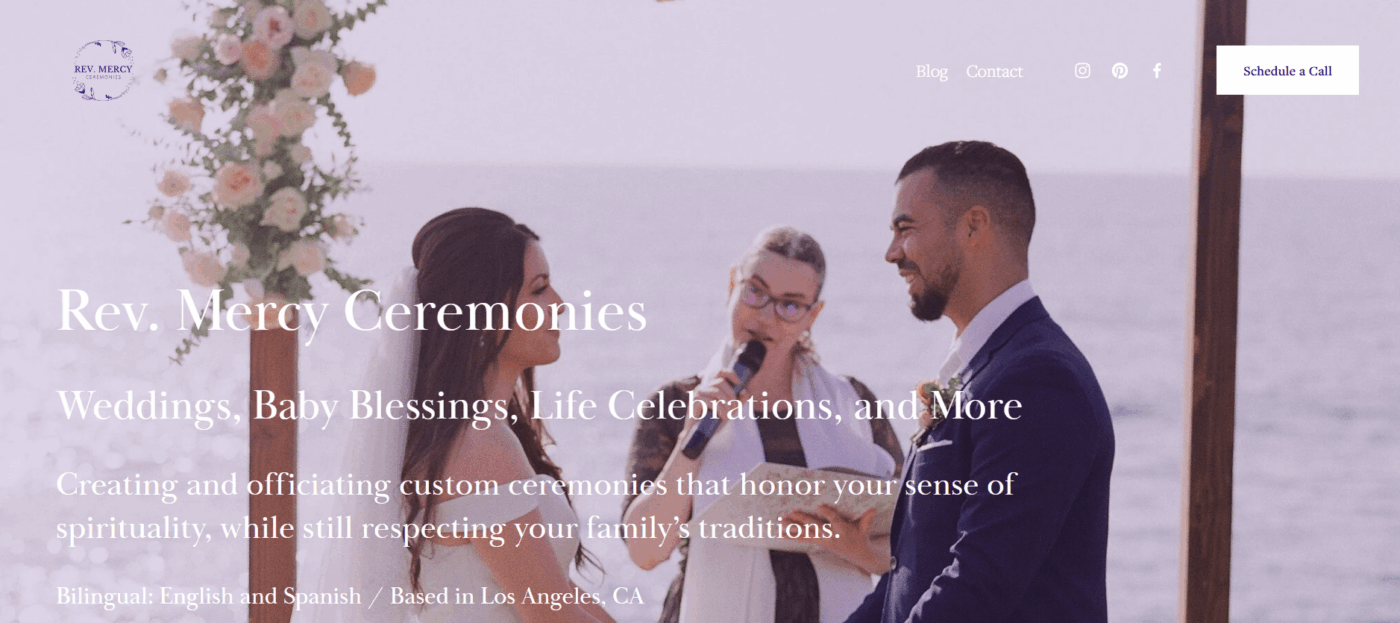
Rev Mercy Ibarra’s wedding officiant website shows her perfect fit statement: “Creating and officiating custom ceremonies that honor your sense of spirituality, while still respecting your family’s traditions.”
Most people would stop there. But Mercy continues: “Creating and officiating custom ceremonies that honor your sense of spirituality while still respecting your family’s traditions.” This is what we call your Perfect Fit Statement and you’ll learn how to create your own inside The Wedding Business Collective.
Mercy is a first-generation Cuban American. She works with Hispanic couples who are in a similar position. They’re first generation. Their parents are much more Catholic than they are. They’re culturally Catholic, and they want to have a ceremony that reflects them but also respects their family’s traditions.
See how specific that is? This is the problem she solves. She clearly stands out to her ideal client, and you can tell her apart from other officiants.
Another great example is Kay Northrup, a destination wedding planner I’ve worked with in The Wedding Business Collective.
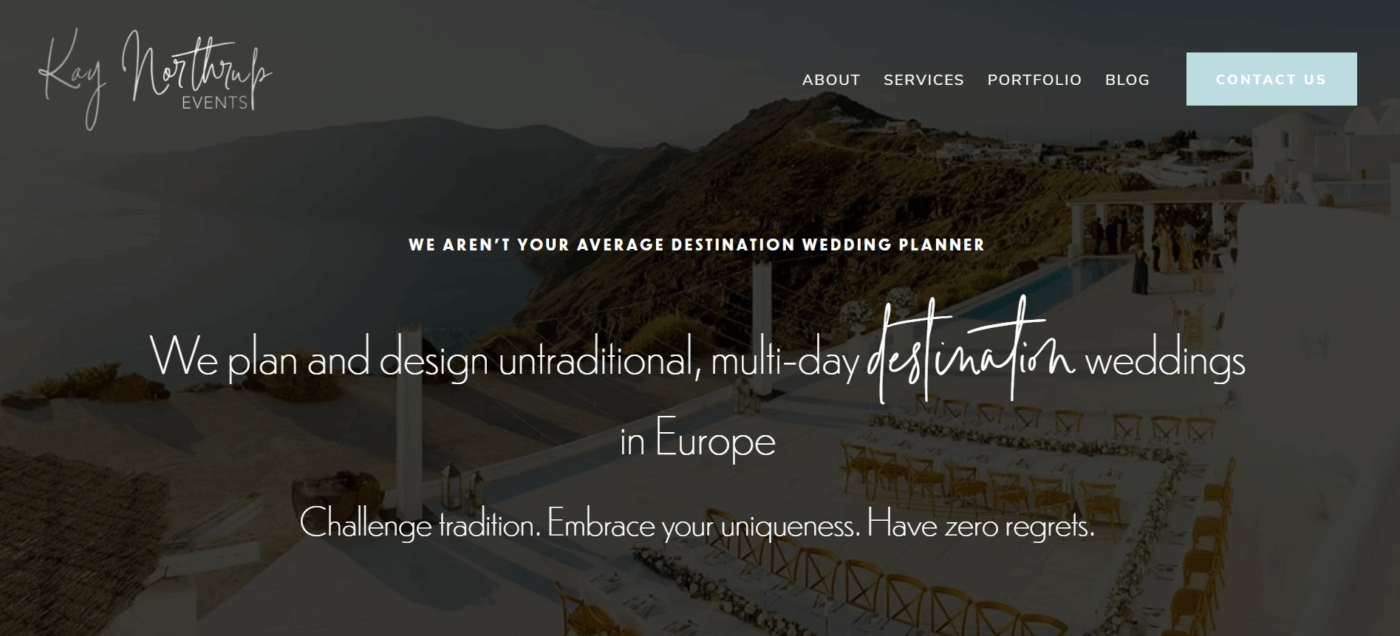
Kay Northrup’s wedding planner website shows her perfect fit statement targeting untraditional, multi-day destination weddings in Europe.
Her website immediately tells you: “We aren’t your average wedding planner. We plan untraditional, multi-day destination weddings in Europe. Challenge tradition. Embrace your uniqueness. Have zero regrets.”
Someone reads this and they understand if this is for them or not. We need this so badly in our industry because everybody is just blending in.
Why this matters: When your messaging resonates, you stop competing on price. You become the obvious choice for YOUR people. They see themselves in your words, and they think, “This person gets me.”
Part 4: The “How”
Now, and only now, do you get tactical. If you skip to this step without doing parts 1-3, I can promise you that your marketing will flop.
This is where you decide:
- Which marketing channels you’ll use (and which you’ll ignore)
- What you’ll post and when
- How you’ll promote your content
- What you’ll focus on this quarter in your quarterly plan
But here’s the key: Your tactics aren’t random. They’re strategic actions based on the foundation you’ve built.
You’re not posting on Instagram because you feel like you have to. You’re posting on Instagram because your research showed that’s where your ideal clients engage with wedding vendors, your messaging is dialed in, and you have a specific goal you’re working toward.
Why this matters: Without the foundation of Parts 1-3, your tactics are just busy work. With that foundation, your tactics become strategic actions that move you toward your goal.
Part 5: Measurement
You need to know what’s working. Period.
This means tracking your KPIs (key performance indicators), knowing where your leads come from, and reviewing your results quarterly.
What gets measured gets improved. It’s that simple.
If you’re not tracking where your consultations are coming from, you have no idea if that $3,000 you spent advertising on The Knot was worth it. If you’re not tracking how many consultations convert to bookings, you don’t know if you have a lead generation problem or a sales problem.
Why this matters: Without measurement, you’re just guessing and probably making the same mistakes over and over. With measurement, you can see what’s working, do more of it, and stop wasting time on what doesn’t.
How This Framework Helps You Book More Clients (And Why DIY Is Harder)
This framework works because it’s strategic, not reactive. You’re not throwing spaghetti at the wall. You’re making intentional decisions based on real data about your business.
But here’s what I see happen when people try to DIY this:
They skip the research. It feels boring compared to curating your Instagram aesthetic. But without it, your marketing falls flat because you’re making assumptions instead of basing your strategy on reality.
They can’t see their own blind spots. You’re too close to your business to objectively analyze your competitors or identify your true differentiators. You need an outside perspective.
They don’t follow through on measurement. Life gets busy. The plan sits in a folder. Nothing changes. Three months later, you’re still wondering why you’re not getting more inquiries.
They get stuck. Questions come up. Assumptions need testing. And there’s no one to ask. So the plan stays half-finished, and you go back to doing what you’ve always done.
That’s why inside The Wedding Business Collective, you don’t just get the framework. You get:
- Step-by-step guidance through each part
- Templates and worksheets to help you implement
- Daily coaching in the group and Monthly Mastermind Calls to keep you on track
- A community of wedding pros working through this alongside you
- Feedback on your actual marketing plan
- AI tools to help analyze your research and generate marketing ideas quickly and easily
Example: Katie, a wedding planner struggling with marketing, joined The Wedding Business Collective when her business was brand new and she wasn’t getting a single booking. Through the research and planning process, she built a marketing system based on what actually works for her business.
The result? She booked 29 weddings in a year, with 16 of those coming in just a six week period. She finally has a system that works and isn’t constantly second-guessing herself anymore.
During the podcast interview I did with Katie, she said “The structure you provided helped me realize I knew how to plan a wedding, but I didn’t know how to run a business. That foundation made all the difference.”
That’s the power of having the complete framework plus implementation support.
What Happens When You Skip Steps (The Instagram Trap)
Let me guess: You’re posting on Instagram regularly, maybe even daily, hoping it will bring you clients. You’re doing reels. You’re engaging. You’re following all the “expert” advice.
And you’re still not getting the inquiries you need.
Here’s why: You jumped to Part 4 (tactics) without doing Parts 1-3 (goal, research, messaging).
So you’re:
- Posting content that doesn’t resonate with your ideal client (because you haven’t defined who they really are and what they care about most)
- Using messaging that sounds like everyone else (because you haven’t differentiated yourself)
- Spending time on a platform your clients might not even use to find vendors (because you haven’t researched where they actually come from)
- Measuring vanity metrics like followers instead of what actually matters (because you haven’t set real goals)
This is the Instagram trap. And it’s exhausting.
You’re busy, but not strategic. You’re active, but not effective. You’re working hard, but not getting results.
The solution isn’t to post more. The solution is to do the foundational work first.
When you have a real marketing plan, you might discover that Instagram isn’t even one of your top lead sources. You might discover that your time is better spent somewhere else. Or you might discover that Instagram IS important, but you’ve been using it wrong because your messaging was off.
Either way, you stop wasting time and start getting results.
From Scattered to Strategic: What Gets Wedding Bookings
Most wedding pros think they need to pay to advertise on The Knot and WeddingWire to get clients but in the independent research I conducted on my audience of thousands of wedding pros, only about 20% of people who pay to be featured on these platforms actually get a positive return on their investment.
Even people who had success with these platforms before are finding it’s not working as well now. Why? Because couples are shopping differently, and these platforms aren’t built to help you stand out. They’re built to make you look interchangeable.
When you rely on third-party platforms, you’re gambling with your lead flow. You don’t have the ability to generate leads whenever you need them. And it’s YOUR business. You should be able to do this.
That’s why you need a marketing plan that allows you to generate your own leads that are the perfect fit for you.
Forget the advice to be everywhere. Real marketing isn’t about doing everything. It’s about doing the right things.
The wedding professionals who consistently fill their calendars aren’t the ones posting on social media 5 times a day on every platform. They’re the ones who know where their clients actually come from and focus on showing up there with the right message. The one that’s perfectly aligned with what their ideal clients really want.
That’s what this framework gives you: clarity on what works for YOUR business, not what works for someone else’s.
How The Wedding Business Collective Helps You Book More Weddings
I created The Wedding Business Collective because I was tired of seeing talented wedding pros struggle with marketing.
Not because they weren’t good at what they do. But because they were:
- Overwhelmed by all the options
- Comparing themselves to everyone else
- Doing ALL THE THINGS without a strategy
- Guessing instead of measuring
- Missing the foundational work that makes marketing actually work
I wanted to create a place where wedding pros could get a proven framework, step-by-step guidance, and ongoing support to actually implement their plan.
Because a plan you don’t use is just really expensive scratch paper.
Inside The Wedding Business Collective, you get:
✅ The complete 5-part Marketing Plan Framework with step-by-step video training for each section
✅ Workbooks and templates for every section (so you’re not starting from scratch)
✅ Monthly group coaching calls where I review plans and answer your specific questions
✅ A community of hundreds of wedding pros who get it. People who understand the unique challenges of marketing a wedding business.
✅ AI tools to help analyze your ideal client research and generate marketing ideas based on YOUR specific business
✅ Accountability to actually implement (not just plan)
✅ Expert masterclasses on topics like Google Analytics, systems and automation, and staying top of mind with referral partners
Real results from members:

Chris, a live wedding painter, said: “Before joining The Wedding Business Collective, I was piecing things together and hoping for the best. Now I have a clear plan. I know exactly what to focus on, how to position my business, and where to get my best clients. When I joined in December, I set a goal for the number of consultations I wanted to get by the end of March, and I’d blown past it already in January.”
 Mercy, the officiant I mentioned earlier, said: “I never sat down to analyze what I’d done. It had always been flying by the seat of my pants. The questions Heidi asked in the planning sessions really made me acknowledge how much I’d done, gave me clarity on what needs to be prioritized, what can wait, and what I can let go of entirely.”
Katie, a wedding planner , said: “I wasn’t getting a single booking before joining The Wedding Business Collective. My business was new, I felt overwhelmed, and this program seemed like a great opportunity to build my business the right way. I knew I needed a plan, but I had no idea where to start. Now I’ve booked 29 weddings in a year, 16 in the last six weeks. I finally have a marketing system that works, and I’m not constantly second-guessing myself anymore.”
The difference between this blog post and what’s inside The Wedding Business Collective:
This post gives you the framework overview: the WHAT and the WHY.
The Wedding Business Collective gives you the step-by-step process, templates, coaching, and community to actually build and implement your plan. The HOW.
You get me in your corner, helping you see your blind spots, answering your questions, and making sure you don’t skip the important stuff.
Your Marketing Plan Only Works If You Use It
Look, I could give you a 50-page PDF with every step of the marketing plan framework right now.
But would you actually use it? Would you follow through? Would you know if you’re doing it right?
Probably not.
Because creating a marketing plan isn’t just about having information. It’s about having clarity, support, and accountability.
It’s about having someone who’s done this hundreds of times saying, “Yes, you’re on the right track,” or “Here’s what you’re missing.”
It’s about being in a community where you can share your plan and get feedback from other wedding pros who understand your business.
It’s about having templates that make the process faster and easier instead of staring at a blank page wondering where to start.
And it’s about having ongoing support to implement your plan, not just create it.
That’s what The Wedding Business Collective provides.
You don’t need a formal wedding business plan sitting in a folder collecting dust.
→ You need a strategic wedding marketing plan with five parts: Goal, Research, Messaging, The How, and Measurement.
Each part builds on the last. Skip one, and your marketing stays overwhelming and ineffective.
I’ve walked you through what those five parts are and why they matter. I’ve shown you the Instagram trap that happens when you skip the foundation. I’ve given you exercises to get started.
But creating YOUR plan? That takes focused work, the right templates, and guidance to make sure you’re not missing anything.
That’s exactly what we do inside The Wedding Business Collective.
If you’re ready to stop feeling overwhelmed, stop guessing, and start marketing strategically, I’d love to help you.
Ready To Create Your Money-Making Marketing Plan?
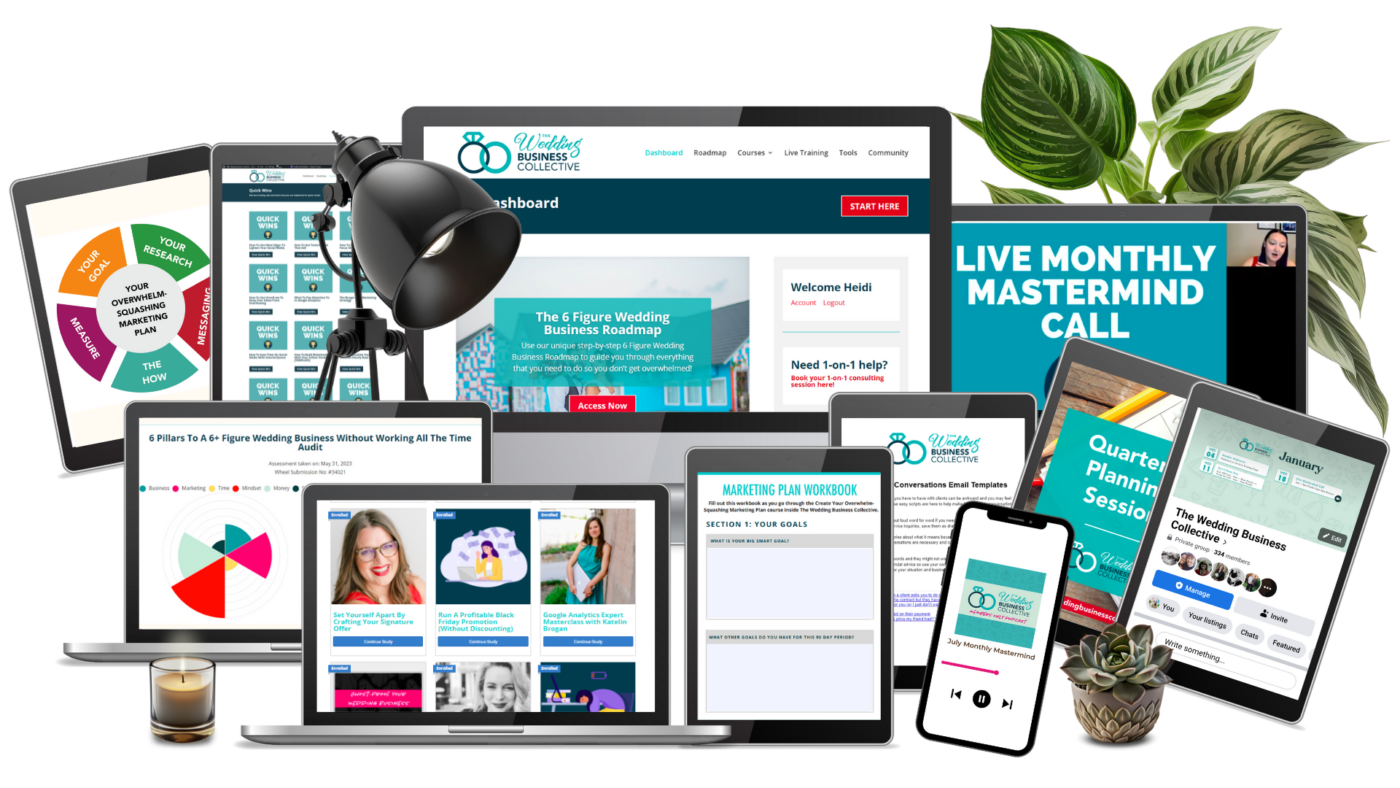
Get instant access to a simple roadmap to book more ideal clients and craft a business that gives you the income, life, and freedom you want. Sound like something you need?