
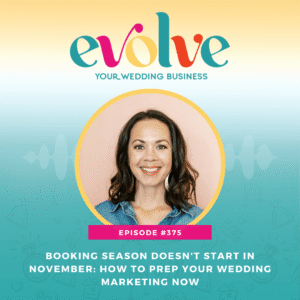
Booking Season Doesn’t Start In November: How To Prep Your Wedding Marketing Now
You’ve got the date circled. The week before Thanksgiving, booking season kicks off, and that’s when you’ll finally get serious about your marketing again.
Here’s the problem with that plan. Couples don’t wait for your calendar. By the time engagement season hits, they’ve already been researching, comparing, reading reviews, and quietly deciding who’s in and who’s out. The wedding pros showing up in that research did the work back in September.
Tayler Cusick Hollman has been working with wedding pros for 11 years and she watches the same thing play out every single year. Busy season eats your marketing. Your business goes quiet, then November arrives and the knee-jerk reaction is to post more.
Posting more is not a plan. We got into what is.
In this episode we’ll cover:
- Why the old marketing rule of seven is dead, and the much bigger number that replaced it
- What’s happening in the four-fifths of the buying process you never get to see
- The reason “that golden hour glow” captions don’t move anyone one inch closer to inquiring
- How to prep for booking season in phases so it doesn’t land on top of your biggest wedding weekend of the year
- What your customer persona actually needs to say about your ideal couple, and why their coffee order isn’t it
- The part of the marketing funnel most wedding pros skip completely, and what it’s costing them
- How to lay out a month of content so you’re not front-loading pretty pictures and hoping someone inquires
- The stat about marketing plans that should make you sit down and write one this week
About Tayler Cusick Hollman
Tayler Cusick Hollman is a marketing consultant turned small business champion and the founder of Enji, a marketing project management tool designed to help you stop just thinking about doing your marketing and actually get it done. After more than a decade working alongside small business owners, Tayler recognized a common challenge: it wasn’t just knowing what to do—it was getting marketing done consistently. She built Enji to solve that problem. And by being one place you can plan and do your marketing, Enji helps small business owners turn ideas into finished tasks that make them money.
Website: enji.co
Instagram: @enji_co
Links & Resources:
The Wedding Business Collective
Get your first 2 months of Enji for $19/month
Clone Your Best Clients
Why Your Wedding Business Attracts Price-Shopping Couples (And How To Change It)
Get my Testimonials That Sell Templates
Want more? To subscribe to the podcast, please use the links below and be sure to leave a review:
Click here to subscribe via iTunes/Apple Podcasts (You’ll just need to click the blue “View In iTunes” button and then click the Subscribe button when your iTunes opens.)
Click here to subscribe via Spotify
Click here to subscribe in any other podcast player
And please take 2 minutes to leave me an honest rating and review on iTunes by clicking here. It will help the show and its ranking immensely! Thank you – I appreciate it!
Still Paying for The Knot or WeddingWire (Because You Don't Have A Plan B)?
So many wedding pros have told me they're not seeing the results they used to from directories.
Discover the proven roadmap wedding pros use to stop depending on directories and finally attract inquiries that lead to bookings.
Transcript: Booking Season Doesn’t Start In November: How To Prep Your Wedding Marketing Now
Heidi Thompson:
All right. Today I’m joined by Tayler Cusick Hollman, who is a marketing consultant turned small business champion and founder of Enji, which you probably know her for. It is a marketing project management tool designed to help you stop just thinking about doing your marketing and actually get it done. And I’m so excited to have Tayler here. I’ve been friends with Tayler for a while now, quite a long time.
And she approached me and was like, we need to talk about why booking season doesn’t start in November, and I was like, ooh, tell me more. So, Tayler, I’m so excited to have you here to talk about this.
Tayler: I am at the most levels of excited to talk to you about this, Heidi. And you know what? I’m going to be back in San Diego in the fall, so we need to get one of our, like, 4-hour brunches on the calendar.
Heidi: Yes. Well, I love you know I love talking about this stuff, we can both nerd out about this all day, but what do you mean when you say booking season doesn’t start in November? Because I can see someone listening and be like, yes it does!
Tayler: Yeah, they’re like, girl, I’ve been in the wedding industry for more than a hot minute, and I know that booking season starts in November and runs through the end of February. And that is, it is not untrue. The thing is that part of booking season is when we start to see the historical spike in engagements. But as a wedding professional, that doesn’t mean that that moment in time is the same moment where you can slash should start to pay a lot more attention to your marketing than you typically do throughout the year. And so, when I see people, you know, I’ve been working with wedding pros for 11 years now. This is not my first booking season rodeo. And what I typically watch all y’all do is wait until like, right the week before Thanksgiving when, in your mind, quote-unquote, booking season starts, and you just react to that and you react by thinking, I should post more on Instagram.
Right? And so, when you think to yourself, when you’ve put yourself in this mindset and on this timeline of bookings, I don’t need to worry about booking season until November. Once it starts, you’re basically already behind with your marketing. And that is not a stress-less way to go about this super important marketing and sales period of the year.
Heidi: Yeah, and I think that’s a really good point. You know, something I’ve been talking about a lot lately is this kind of iceberg situation. You know, what we see, we only see what’s above the surface. We only see you know, people starting to interact with us, starting to reach out, but we don’t see, like, four-fifths of the damn iceberg under the water.
Everything that’s going on, like, all of the research, all of the you know, looking through websites, you know, looking through social media profiles, looking at reviews. I think we’re seeing more than ever, like, just record levels of research and vetting and digging through options than we’ve ever seen in the past. And I mean, there’s data in the past that shows, like, hundreds and hundreds of hours of research, so it’s like oh, cool. Uh, that’s not a huge burden on people or anything, but we are definitely seeing you only see, like, this tiny little part when it starts to involve you, but there is all of this other stuff going on in the background that, you know, as wedding professionals, you’re not necessarily aware of.
I’m curious if you’re seeing that, too.
Tayler: Absolutely. And, you know, for the presentation that I put together for the Book More Weddings Summit that wasn’t too long ago, at the time that we’re recording this, one of the things that I spent a good amount of time researching. Because, you know, marketing data or benchmarks for very small business or wedding industry businesses is not easy to come across. But you know, Heidi, you you have I know you know this old marketing rule of seven, where those were the good old the good old days!
Heidi: The good old days.
Tayler: Where, you know, we could sort of breathe this sigh of relief, knowing that it typically took someone about 7 touchpoints before they were ready to engage with us, like, to buy from us, to inquire, you know, whatever. A conversion looks like for your business. But nowadays. I’ll cut to the chase.
The number’s 25 now for services that cost more than $1,000, which is pretty much every wedding professional out there, minus maybe if you make custom garters. I don’t know that a garter would cost $1,000, but that just is a numerical way of show you know, talking about what you just shared, Heidi, that couples are spending so much time and energy researching the professionals that they are considering before they ever get to the point where they even trust you enough to inquire, right? So, the rule of seven is donezo, and that’s why, you know, that whole iceberg, I love that concept, it’s such a good one, because so much of.
Heidi: Yeah.
Tayler: So much of what we need to do in order to be successful during these, you know, marketing pushes is work that no one sees. And just like our potential clients are doing all of this activity that we don’t see as the business owner. There is an equal amount of stuff that we need to do that is behind the scenes to set us up for having the, you know, publicly viewed marketing that actually gets couples to do the action that we want them to do at the end of the day, which is to say, hey, I’m formally interested in learning more about your services.
Heidi: So tell me more about that, because I can see the knee-jerk response being like, oh, okay, so I just need to post more of the stuff I’m already posting, and I know you know that that’s not gonna cut it.
Tayler: No, and, you know, there’s a couple reasons it’s not gonna cut it. The first one is well, the reason that I this is Tayler’s opinion, this is my hypothesis, my educated guess, but A lot of folks, I know there’s always exceptions to the rule, but a lot of folks during busy season and busy season basically butts right up to the official start of engagement season at this point because October in a lot of geographical areas is you know, the most popular wedding date, or month for a wedding date now. And so, when you are in the throes of needing to do all of the, I’m in the 30-day window activities to get this wedding to actually happen. You know, your marketing falls to the wayside if you haven’t really Set yourself up for consistency through doing something like scheduling out content.
And so, if you’ve put your head down, and well, how do I want to say this? I’m fumbling because I’m trying to say it nicely, but I should probably just say the thing instead of trying to make it nice. You’ve not done any marketing. Your business has become pretty invisible.
In the grand scheme of things. And so, I think that that’s a big part of the reason why the knee-jerk reaction to booking season is, oh my god, I just need to start posting more because I haven’t been. But just doing that, and when you just doing that, and with the most likely approach to it, which is the.
Heidi: Yeah.
Tayler: Finger quote, I made a post just to post approach. That’s how you end up with content that am I I’m putting my hands up in the air, the soft kid gloves are on for this, I’m trying to be kind here that’s how you end up with a lot of captions that say nothing to a potential client who’s reading it. And an example of that would be, that golden hour glow, or here for the details, or what a dream.
Heidi: Mmm.
Tayler: Right? And I see a lot of pros just posting stuff like that at a faster clip than zero as their booking season marketing plan. Do you see that as well? I mean, I have to imagine that you’ve seen that Golden Hour Glow caption as many times as I have.
Heidi: Hold on oh, yeah, and yeah, and I think part of it is people are trying to solve the wrong problem. People think the problem is visibility.
Tayler: Mm-hmm.
Heidi: But the real problem is building desire, you know, making it clear that you have the solution to a problem for someone and making them want to buy that solution. That’s different than just showing up with a pretty picture, and I’ve been this is actually something I’ve been talking about a lot lately, is it’s less about how often you post, how much you’re doing, than it is about the content of that, and what is it doing? What is what belief is it shifting? What is it making them realize?
What is it making them want? What
Tayler: Mm-hmm.
Heidi: Like, how are they then seeing you as different to all the other planners or all the other photographers? And I think that’s something in the wedding industry that we haven’t really talked about that much.
Tayler: Mm-hmm, yeah. Because in the end, it’s not posting more as a plan that works. It’s making sure that you’re saying the right thing at the right time that works. And that’s exactly what you’re talking about, Heidi.
Like, we We are trying to connect with people by showing them that we truly understand. Who they are as people, what they’re experiencing, what they’re, you know, what they’re trying to accomplish. And then, earning their trust. By means of, you know, like, all this marketing that needs to happen to eventually get them to do something.
And that’s why those captions That golden hour glow, even if it’s paired with the most amazing photo, or photos, or B-roll, or professional video from your portfolio. Like, you could say that a thousand times, and it’s not gonna do anything. Because it literally isn’t saying anything, which I’ve already mentioned. And so, during booking season, as you’re preparing for it.
One of the first things that I really encourage everyone who’s listening to do is to go back and revisit, really think about, update or create your customer personas. And Not in a way that you’ve probably likely done it in the past, because honestly. I don’t care if your ideal couple. Is it likes dogs or cats?
Or what their coffee order is like I don’t care about that when it comes to trying to do marketing with results in 2026. What you need to know about the people you’re talking to are the things that motivate them. To do like, to actually do something. Why are they out there, right?
Like, what’s going on in their little brains that you can speak to that’s actually gonna draw them in?
Heidi: Yeah. Yeah. And I think people need to realize that, like, marketing isn’t just yelling into the void, even though it’s what it feels like sometimes. Marketing is psychology.
Tayler: No, totally. Yep.
Heidi: It’s meeting people where they are it’s understanding what they’re thinking. It’s, you know, maybe changing how they’re thinking about something and seeing you as the perfect fit. An example I gave during the summit is you know, if you have a migraine, you go to CVS, and you’re just, like, desperately looking at all of the options in the painkiller aisle, and they all say painkiller, and one of them says migraine relief you’re probably gonna buy that one, even if it’s more expensive, because it’s solving the specific problem. And maybe the other painkillers could, but they’re not specifically saying it.
And you even see it when you start to look for this you start to look for problems and solutions. You start to notice it everywhere in the world. In all of the marketing that’s out there, you see oh, okay, I see they’re speaking to this particular problem, and they’re positioning themselves as the solution to that problem. So it’s really that connection between those two that is missing for a lot of people, because everybody has gorgeous work.
Tayler: Mm-hmm.
Heidi: That is I actually did a presentation, during the summit called, like, being good at what you do isn’t good enough.
Tayler: Mm-hmm.
Heidi: Because it’s not like everybody is and that is not in itself a differentiator. And that doesn’t help someone see you as, oh, this person has the perfect fit solution for me. And everybody else is trying to sell me, you know, just photography or whatever it may be. So.
I’m really glad you brought that up, and it’s a it’s a difference between just showing your work. And showing that you understand someone’s problem and presenting them with a solution. They’re two very different things.
Tayler: Totally, and you know what? The problem that engaged couples have is not they’re getting married for the first time. It’s not that’s not the actual problem. The problem that they’re experiencing is one that oftentimes they won’t admit.
Heidi: Right.
Tayler: To themselves, to other people, right? Like they may not ever verbalize it, but they feel a very specific problem. And so, yeah, like that, I love your, again, your example of painkiller or migraine relief. And so if you’re out there just posting more, only sharing inspirational content and speaking to the most generic customer problem that you can, that is going to make it exponentially harder for you to get people really, like, truly interested in the work that you do, and whether or not you’re the right pro for, you know, their wedding celebration.
Heidi: Yeah. And if you’re like, how do I figure out what that problem is? I mean, my method is definitely to go directly to your people. I’ll link to the Clone Your Best Clients book in the show notes if you wanna grab that so you can see the exact process of, okay, what are they thinking?
Because the way you speak to someone who’s like, I’ve been to 14 weddings, I hate them, they’re the same thing over and over again, I’m so bored the last thing I want to do is bore my friends and family. I want them to be talking about it. I don’t want to be that wedding that they look back on and think, oh yeah, another wedding we have to go to. I want it to be different.
I want it to be fun or whatever it is the way you talk to that person and the content you create to talk to that is so much different and so much more specific than. Hey, you’re getting married, you know?
Tayler: Mm-hmm, totally.
Heidi: So, I know when we were talking before, you had mentioned that there are phases that people really need to move through here can you tell me a little bit about that?
Tayler: Yeah, you know, and I like talking about preparing for booking season in phases because I have way too many wedding planner friends. It’s why my family thinks that I’m a wedding planner. Clearly not. But most wedding professionals understand the concept of phase based planning, even if that’s not exactly how you go about things.
And the reason that I like talking about this in a phase-based approach is because there are many things that can be done in order to set yourself up for marketing success once, you know, people start popping the question. And those many things add up into many hours of additional marketing effort that you would need to be putting into things, right? This is not in lieu of what you need to do in order to just have like your baseline consistent visibility or posting schedule. It’s in addition to so breaking this sort of list up into phases is how you can make it more bite sized and more palatable, more doable when it’s also still coinciding with like again, you’re in the 30-day window for the biggest wedding weekend that you’re gonna have all year.
So, that’s why I like to do the sort of phased-based conversation around prepping for booking season.
Heidi: That makes a lot of sense, and it definitely makes it easier to, you know, focus in on different areas. So, what do they need to be covering across these phases?
Tayler: Yeah, I’ve already mentioned updating your customer personas, and that’s always where I like to point people first, because everything that we do in marketing is for that person. And so if you don’t understand them deeply, or maybe you just need to refresh your memory around who this person is that you are trying to talk to, then, you know, if you’re. If you’re out here talking to couple B when you should be talking to couple A, then, yeah. No wonder your marketing doesn’t work at the end of the day.
So looking at your customer personas, you know, figuring out how you can clone your best clients like Heidi can teach you how to do like that to me is step one. And then after that you know, there’s this thing that people, uh, like, end up complaining about many years later, where they go, why am I I don’t feel like I’m making enough. And so, as you’re prepping for booking season. Make sure that your pricing is still profitable for where you are in your business, and that that number could need to get bumped up for any one of, you know, a half-dozen reasons.
But making sure that your services are priced where they need to be, and also Include the things that your ideal couple wants. Um, as well as maybe you need to take away some things that you’re like, oh, I’m never doing that again, because that always happens every year. Like, making sure that your services, your packages and pricing are locked down is another part of this initial phase of things that’s again, the work that no one sees. And then the big one in this first phase of prepping for booking season is going through and doing a brand and a website audit, because oh, my goodness.
The deep breath can’t be exhaled deep enough for how I mean, I do spend a lot of time snooping around on everybody’s websites. I’m sure, Heidi, you’re the same. We see a lot of things, and one of the things that I see way too often.
Heidi: Yep.
Tayler: is one, you know, one business’s brand is showing up and speaking about themselves or their services in 8 different ways. Like, it’s one way on Instagram, it’s one way on their website, it’s one way over here, one way over there, and that is so confusing to a couple who is, like, going around and doing the same sort of sleuthing that you and I do. So, going through and doing a brand and website audit to make sure that you are actually saying the right things to your ideal couples, and that it’s consistent, both in message and visual brand identity, in all of the places that you’re showing up, is how I would close out that first phase of booking season prep that is the work that’s more behind the scenes.
Heidi: That makes a lot of sense. And I think so often with our brands and our websites, we can be like, oh no, I’m clearly communicating that and you go back and you look at it and you’re like, yeah, I haven’t actually said that anywhere. I just thought I did.
Tayler: Totally. Or, like, the little internet gremlins went and broke all of the buttons on your website. You’re like, I swear that that worked, and why is it broken now? So, those are all really important, but super foundational things that people can do.
Heidi: Right. So what is the phase that follows that?
Tayler: That one is where you’re starting to build up from, you know, all of the back-end, behind-the-scenes work, and you’re starting to set yourself up for the actual marketing that you are going to do throughout booking and engagement season. And so one of the things that I also see sort of falling to the wayside throughout the year is consistently getting new reviews from all of the couples that you’ve worked with throughout the year. And even if asking for a review is a part of your formal off-boarding process. People don’t do things the first time we ask them to do it a lot of the times.
And so going back and looking wherever you collect reviews, whether it’s your Google business page or people are emailing them to you, like going back and seeing, okay. Who? Who did I work with in the last year that was pretty close to my ideal client? can I ask for a review because they haven’t left one yet?
So, that’s another, like, task that you can do in this second phase of things. And then, because I am a content-based marketer, um, this next thing is a little bit skewed toward that, but I would really encourage people to spend time updating old blog posts that have been performing well for them. If search like, if being found on the internet via Google or the chatbots is something that you prioritize in your marketing. Because again, these are the things that we go through life knowing we can do, we should do it, we want to do it.
But they can slip through the cracks, and so whatever your version of updating old blog posts is, or maybe it’s just, like batch writing new ones, or, you know, whatever sort of main marketing channel you’ve been leaning on dedicating time to actually doing that work is super important. And then I need people to start planning out what they’re going to be saying in the future, and not just winging it. And I know that, Heidi, you and I are both uber fans of creating a marketing plan so that you don’t have to build the plane as you fly it every day, but that is how I would close out the, you know, second phase of, okay, how am I going to sit down and set myself up for a really effective marketing. Push during booking season.
Heidi: And I will say, we are not fans of this because we’re like, this is the best possible way you can do it, and we’re, like, A-plus students. No, this will just make your life easier. A good marketer is lazy and will try to find ways to make life easier. And this is definitely one of them planning it out.
You know, I talk about having the CEO version of you and the worker bee version of you, allowing the CEO version of you to make all these decisions.
Tayler: I
Heidi: So that worker bee you can just show up to work and know exactly what you need to work on, what you need to do. You don’t have to think about it. You don’t have to invent it. You don’t have to strategize about it.
You just get to basically fulfill the work order that you created for yourself when you were in that more strategic frame of mind. And it saves so much time and so much energy.
Tayler: Absolutely. And you know, I love that phrase, good marketers are lazy. You need to put, you need to make some merch out of that, Heidi.
Heidi: Because we’re not out here just trying to do marketing for the sake of it. We’re not out here trying to do more work. We’re out here trying to get the best results possible, ideally with as little work as possible. If we can make it work, then great.
But all of these things, and putting this time in ahead of time, it’s basically the equivalent of when you see, like, a cooking show, and they have all their ingredients portioned out, and everything’s ready to go so they can just, you know, do the cooking segment and get it done. It’s that it just makes it so much easier and so much smoother.
Tayler: Mmhm. Totally. Yeah. And you know, one of my favorite stats from the State of Small Biz Report that we created last year, we’ll do it again this year, but last year’s stat was the business owners who had a marketing plan were 3 times as likely to say that their marketing was very or extremely effective.
And I I think it is because or I stand behind you in that whole you know, your CEO-level self has time reserved to do that type of and that part of the work. And then your worker bee self can just get the job done. Because when the worker bee has to figure out the job at the same time, it’s going to be shoddy work, right? It’s going to be shoddy.
So of course it’s not going to be very or extremely effective. So those two things absolutely go hand in hand. And so it is kind of, I will forever be shocked.
Heidi: Yep.
Tayler: At the frequency that I see wedding pros just totally waking up and winging it with their marketing, especially during this time of year.
Heidi: Yeah, that’s definitely playing on hard mode.
Tayler: Huh.
Heidi: And it doesn’t work. So, you know, there’s the effort going in and then the result not coming back. But.
Tayler: Yeah.
Heidi: I know you’ve talked about, you know how the marketing funnel impacts the content. And you were saying, you know, I’m a marketer that’s really focused on content. When we’re looking at what sorts of content we’re creating, what do we actually need to be keeping in mind? Because we know it’s not enough to just say, like, basically some effect of, hey, look at this beautiful photo or this beautiful video.
Tayler: No!
Heidi: So what do we need to be thinking about?
Tayler: Okay, so there’s there’s a lot of things to be thinking about, which is why I think people’s eyes roll back into their, like, the depths of their skull when we’re talking about marketing content. Because when you actually sit down and think about all of the moving parts, the psychology of marketing and the behaviors that you’re trying to get someone to go through, this is not a linear thing. It’s not a clean, like, step one, step two, step three formula, and so if I were, you know, if I had to boil this down in the simplest way that I can you need to make sure that your content is giving people what they need to see, hear, and feel. In order to Do whatever action it is you want them to do, which is most likely submit a formal inquiry.
But there are different ways that you can present that content to them. And that content shifts depending on how familiar that person is for you and that’s where, like, something as simple as, give people what they need to see, hear, and feel becomes, like, baby da bopper da brrrr, like, very complicated, and people listening are probably like, okay, Tayler. This just this just got it just it feels like it just got complicated. But.
In the end when you look at your if you were to, like, open up your Instagram profile right now, and I’m picking on Instagram because I know that that is an incredibly important marketing channel for most wedding professionals. If you were to open up your Instagram profile and start scrolling through, you know, the last few months of posts that you’ve gotten out there. I would ask you to look at that content through the lens of sort of content pillars. And I know that there’s, like, a bazillion ways to define content pillars, but as someone who has built software, like, I’ve had to uncomfortably standardize things to make them work as software.
And so, the like, the most top of funnel, which means someone’s just learning about you, content pillars, are entertain and inspire. And wedding pros are real good at the inspirational content, right? Like, that’s, for the most part, what I see you doing. But if you scroll through your content, and all you see is stuff that is meant to entertain or inspire people, then your marketing.
Is staying in this part of the funnel that’s only meant to get new eyeballs on you, right? But in the end, being visible isn’t enough. So. If what you’re missing is then content that actually educates people about what you do, your process, your unique point of view, what makes you different, right?
There’s a whole that’s, like, the whole middle part of a traditional marketing funnel that you’re just not doing. And then at the bottom, there’s a space where you are supposed to sell. And a lot of wedding pros are just, like, too damn nice. And you won’t actually get to the point where you are asking for the proverbial sale, which is more like giving people a very easy, short, straightforward path to inquiring.
And at the bottom, that sits at the bottom of your marketing funnel, that’s where you are helping people understand what your availability is, right? How far in advance should they be reaching out to you if their wedding is 18 months away, right? Like, there are all these things that Are different pieces of information? that collectively will get someone to the point of going, okay, I’ve, like, I’ve seen what I need to see, I’ve heard what I need to hear, and this person has also made me feel like they understand who I am and what I want.
And then, that’s when that inquiry is most likely to happen, but you know, to bring it back, it’s not 7 pieces of content that it’s gonna take to get all of that across. It’s more than 3 times that, which is why I Everyone here, if you’ve been You’ve likely been in Heidi’s orbit or mine for more than a hot minute. And that’s why we are like, hey, consistency is important for that reason.
Heidi: I love the way that you broke this down. And just as I’m hearing you describe it, you know, I know a lot of times sales funnels are analogize to, like, relationships, and it’s kind of like the seeing someone on a dating profile, dating them, and choosing to continue dating them, and marrying them. Like, there’s a span, right? It’s like, the things you need to find out about a person to want to continue down this path changes as the familiarity grows closer.
And I think a lot of people, like you said, they’re excellent at the entertain, at the inspire, at the look how gorgeous this is, this could be you, but it’s like you’re getting found on the dating app, and you’re never going on the date. You know, you’re never actually showing them like, oh, no, I thought this person would be pretty cool. Turns out they are and I want to, you know, continue this relationship. So I think looking at it in that way of.
Tayler: Mmhm.
Heidi: Top of funnel, that like discovery, inspiration, um, entertainment, that middle of funnel, you know, the education and what makes you different and all of these things that are so important to making decisions about who you want to work with and then the bottom of funnel, like, here’s how you do that, like, here’s how to take the next step with me, basically, is so incredibly crucial, and I think overlooked. Because, like you said, it’s too nice. Hey, guys, you know what’s nice?
Tayler: Money!
Heidi: And I was going to say solving people’s problems, but I like your answer better. Yeah.
Tayler: Okay.
Heidi: So we have to give, like, you’re not really doing someone a service who could really benefit from you by not being like, hey, I can help you let me help you, you know, instead of just being, like, more gorgeous photos and hoping that they make the connection. It’s like you’re having this great conversation with someone on a dating app, and nobody’s proposing a date. Like, let’s move this forward.
Tayler: Yeah, and eventually you just get you’re like, okay, this is weird, I’m is it are we are we doing this, or are we not, right? And you don’t want
Heidi: Yeah, and eventually you see it. You’re like, okay. Yeah.
Tayler: someone who’s considering working with you to feel that emotion, right? You want them to feel like they can continually, like, get closer to you, and that it’s safe to do that, and that it’s it would be exciting and good to do that at the same time. So, yeah, it’s like, that’s why I know I’ve said it a few times, but a lot of marketing that I see happen in the wedding industry is just marketing that isn’t really saying anything. And, you know, I know that that is
Heidi: Yeah. Okay.
Tayler: a function of being very time poor, being emotionally and physically exhausted, feeling like you’re pouring all of your creativity into your client work and not having anything left over for yourself at the end of the day. I 100% will always recognize that the work that wedding pros do is like a full body experience. So but I also know that everybody has big lofty goals that they want to achieve. And so when you have these visions of the future, whether it’s your future wedding season, whether it’s your future self five years from now, right?
Whatever version of the future you’re thinking about you gotta do something different, and it’s going to take effort to get from point A to point B. It doesn’t just land in your lap. Yes, there’s always the unicorn that that seems to happen to, and we can all just perpetually be jealous of those people, but for the rest of us, humans on planet Earth who are trying to build businesses, it requires effort and planning and follow-through and dedication and, you know, walking away from it when we need to and coming back to it, you know, in a really excited way. It’s not this clean process, but it can be cleaner if you do a few things to clear the way for yourself.
Heidi: Yeah, and even just being able to ask yourself and organize it that way of like, okay, if, uh, if Instagram is a major marketing channel for me, what am I posting this month that is top of funnel, is middle funnel, and is bottom funnel? And I’m curious, like how you would recommend organizing that, because I can see a lot of people thinking maybe a little too linearly about that when people are in different places on that journey.
Tayler: Mm-hmm. You know, this is the only way I can verbalize it is in a linear way, because if I were to describe some, like, chutes and ladders approach to it, I think I might break some brains in the process. But, you know, to explain it in a linear way, but also very much encourage everyone who’s listening to adapt this to their calendar. You know, if you look at a typical calendar month, there’s four weeks.
Each one of those weeks can be about a different part of your marketing funnel. So the first week you’re really leaning into, I need to entertain and inspire people to get, you know, top of funnel content created. And then the next week you can give them more content that is, yes, sometimes entertainment, sometimes inspirational, but also starting to mix in educational content to give them that like, oh, you should you like what you see? Like, stick around, stay a while, sort of stuff.
And then the third week would be mostly educational content in an effort to get people to know, like, and trust you and then the fourth week, you could think of as your promotional content, where you’re going to very clearly show people what’s your availability, what’s the next step. And so that’s my linear way of describing it. But again, people as long as you’re creating posts and peppering them throughout the month that covers each one of those things, then you’re doing right by your marketing, because the body of work every month that you’re putting out there would cover all of your bases.
Heidi: Yeah, and I like that so if you want to do the weekly focus, you can, and then you can just repeat that structure and continue with it. Or you could even do something where, like, okay, I’m posting three times a week. It’s going to be one top, one middle, one bottom. So then, regardless of where they are.
Tayler: Mmhm.
Heidi: they are taken care of in any given week, but I can see people maybe getting a little too into front-loading the top and being like, oh, well, I’m not going to talk about middle or bottom until, like. February. That’s not what we want.
Tayler: That no, that would be a mistake.
Heidi: Definitely. Yeah. And it’s, you know, it’s a thing. You don’t know where people are you don’t know where they are in their decision making.
So you have to be giving them options to move.
Tayler: Like.
Heidi: at their pace. If they choose not to move forward, that’s fine. Like, catch them in the next week, catch them in the next month that you’re rotating this, but you have to give them the opportunity, and I think that’s something a lot of wedding professionals miss.
Tayler: I’m I’m sitting here aggressively nodding my head in agreement with you so, because in the end, we we do not control. When people are going to decide that they’re ready to take the next step. But we do control whether or not we’ve created those opportunities. Right, Heidi?
Like whether or not we’ve showed up, whether or not we’ve said more to them than I’m going to keep picking on that golden hour glow. Sorry, photographers, you probably hate me at this point. But, you know, you have to, as the business owner who’s trying to.
Heidi: Yeah.
Tayler: get people to inquire, create those opportunities. And so that is that is the one of the most core functions of your marketing, if not the most core function of your marketing, right? Is to make sure that when someone is ready to potentially give you their money, that you are there to receive it.
Heidi: Absolutely. And I think this framework can be an easier way for people to think about their content. So it’s not just like, what should I create? That’s like the, what should we have for dinner conversation?
Nobody wants to have that but if it’s like.
Tayler: Oh, my gosh. No.
Heidi: Am I going to make something? Are we going to go out to eat? Or are we going to order something? Like, okay, now I have options.
Now I can work within this or do I want Thai? Do I want pizza? Or do I want sandwiches? It just tightens the focus enough so that it is less overwhelming.
And I think if you think about, like okay, I’m gonna make 4 top-of-funnel pieces of content, 4 middle-of-funnel pieces of content, 4 bottom-of-funnel you are gonna be so much better positioned than someone that’s just flying by the seat of their pants.
Tayler: 100,000 million percent.
Heidi: Tell us how Enji can help people put this to work, because so much of what Enji does is the, alright, we got these ideas, let’s actually do the thing.
Tayler: Let’s do the damn thing. I mean, that is the reason that Enji exists is because I personally am on a mission to solve the I do my own marketing problem. And so much of the I do my own marketing problem is. I think about doing my marketing a lot, but I don’t actually get it done as much as I think about it.
And so, there’s a couple things within Enji that were that are especially helpful for wedding pros, and the first one is there’s a whole booking season.
Heidi: Thank you.
Tayler: campaign template in Enji that maps out all of the tasks that you can think about doing in order to prep for booking season. And it maps it out in a phase-based approach where the tasks, all of the prep tasks are spread across a little more than two months. So, like, you know, you might get in there, if you’re trying it for the first time, you might get in there and click on, oh, let’s start the booking season campaign, and you might have some red dates in there, because there might already be a few items that are past due, but, you know, it’s just because it’s my attempt to help people schedule their workload in a way that’s realistic for them to do, instead of, like, oh, I’m gonna do all of my booking season prep two days before Thanksgiving, when my in-laws are in town and I’m hosting dinner for 18. So that’s one of the things that is really helpful, like very specifically to this conversation.
But the other thing is the calendar is absolutely the place that I live the most in my Enji account. Because not only can I create tasks to, like, project manage myself and how I’m getting this marketing done, but it also is the same place where I can do all of my social media scheduling and put blogs on the calendar and draft them, so I end up with and anyone who uses it ends up with this bird’s-eye view of all of the marketing that’s happening now and next. And one of the reasons that I know you and I are, like people, please plan all the things, is because when you see it coming, then it’s way more likely to actually happen. And so, um, people can, like I said, plan out their social media content, you can post you know, using the social media scheduler, so, you know, even on October, I think it’s 22nd this year, or 24th is, like, you know, the most popular wedding date, like, even in that week, you can feel confident that your Instagram posts, or your Facebook posts, or whatever.
They’re actually still going out to help you build up that marketing foundation for once booking season starts in November. So, like I said, in the end, I really just want people I do. I want for people to find something, some way to stop just thinking about their marketing and actually get it done. And if that’s Enji, fantastic.
If it’s another way that you can hold yourself accountable, fantastic. Like equally so don’t I want to hear fewer people complain about how hard it is to get their marketing done at the end of the day. That’s my only wish.
Heidi: Yeah, I’m with you and I’ll definitely link to Enji in the show notes. Tayler, this has been such an interesting conversation. Where can people go if they want to get in touch with you?
Tayler: Our website is enji.co, and if you are into, like weird voices, entertaining content, all that kind of stuff, of our Instagram account. I have lots of fun with my marketing, and I hope it’s abundantly clear to folks, but our Instagram account is @enji_co.
Heidi: It is fun. I thoroughly enjoy it. It’s, yeah, it’s refreshing. Thank you so much for being here, Tayler.
I appreciate it so much. This has been a great conversation. I will link to all of that in the show notes so you guys have it. And, Tayler, thanks again for being here.
Tayler: Thank you so much, Heidi, and we’ll get our 4-hour brunch on the calendar.