

Episode 249: Behind The Wedding Business with Mercedes Ibarra of Rev. Mercy Ceremonies
When Mercy Ibarra started out, she was charging too little, marketing herself like every other officiant, and treating her work like a side hobby instead of a business.
Then she got crystal clear on exactly who she serves. Now her ideal clients find her, repeat her marketing back to her word for word, and she has more than doubled her prices.
🔽 Scroll to the bottom for a full transcript of this podcast episode.
This Wedding Officiant Business Had The Talent. It Just Didn’t Stand Out Yet.
Mercy Ibarra never planned to do weddings at all.
She went to seminary to do end-of-life work. She wanted to be a death doula. Then a friend asked her to officiate his wedding because he couldn’t find anyone who spoke Spanish and actually understood his spirituality, and she fell in love with the work. A literal 180 from where she thought she was headed.
But loving the work is one thing. Building a business around it is another.
Mercy is a bilingual Latina interspiritual minister in LA. She serves couples who are spiritual but not religious and want a ceremony that honors who they are while still respecting families who would rather see them married in the church. It is a delicate balance, and she is one of the only people trained to pull it off.
Her work is meaningful and specific. Her marketing, at first, was neither.
What “Playing At Business” Looks Like For A Wedding Officiant
 There’s a version of this a lot of officiants and celebrants know well.
You’re getting clients, but they come from the same couple of directories everyone else is on. Your messaging sounds like everyone else’s. You’re charging what feels safe instead of what you’re worth. The work is good, but the business feels more like a side hobby than a real thing.
For Mercy, that looked like:
- Relying on WeddingWire and The Knot as basically her only marketing
- Generic messaging that didn’t say who she was actually for
- Charging too little because she wasn’t sure people would pay for what she did
- A business that, in her words, didn’t yet feel like a real business
She had the training, the talent, and the heart for it. She just hadn’t made herself findable to the exact people who needed her.
Why She Joined The Wedding Business Collective
Mercy had been listening to the Evolve Your Wedding Business Podcast long before we ever met. When she joined The Wedding Business Collective, she was looking for the thing most wedding pros are missing: a clear way to position herself so the right couples choose her over everyone else.
That’s the whole game inside the Collective. You don’t compete. You make yourself the go-to person for one specific kind of client, so it stops being an apples-to-apples comparison. Could a couple hire a different officiant? Sure. But they don’t want a different officiant. They want Mercy.
How Getting Specific Grew This Wedding Officiant Business
The single biggest shift for Mercy was getting clear on her brand story and her ideal client.
She worked through who she actually serves and what makes her different, then rebuilt her website around it. Her interspiritual ceremonies for the Latino community. Spiritual but not religious. Honoring the couple and their families at the same time. That became her message, and she ran it everywhere.
“That has been the number one game changer for me getting ideal clients that I really love,” she said.
Why Getting Specific Is The Best Move A Wedding Officiant Can Make
Here’s what happens when your messaging stays general: you sound like everyone else, and the only thing left to compete on is price. That’s a race nobody wins.
When you get specific, something else happens. The exact right people see themselves in your words and feel certain you’re the one.
Mercy sees it constantly now. Couples email her describing what they want, and they’re basically reading her marketing back to her.
“It’s like they’re reading my marketing message to me verbatim when they’re writing an email to me. And that’s been amazing,” she said.
That’s not luck. That’s what specificity does. And it works both ways. She’s not just attracting more couples, she’s attracting the couples she actually wants to work with.
“You find your people and they find you,” she said.
How She Updated Her Officiant Messaging Without Starting Over
Mercy didn’t burn her website down and rebuild from scratch. She took her clearer brand story and updated everything to match it, her website, her WeddingWire profile, her Knot listing, piece by piece, until all of it pointed at the same ideal client.
Same business. Sharper message. Very different results.
Treating Marketing Like Experiments Instead Of Pass/Fail Tests
Not everything worked, and that’s the point.
Mercy tried a bridal show. She spent real money on a banner and materials, met a lot of people, and walked away with two decent leads. One ghosted her. The other wasn’t her ideal client at all.
Most people would call that a fail and never look back. Mercy got curious instead. She dug into why. Were people getting hung up on the word “bilingual” and assuming she only worked in Spanish? Should she lean harder into the interspiritual side at her table? Did she actually follow up with the lead list afterward? (She didn’t, so she’s not even sure she gave it a fair shot.)
That instinct, to ask why instead of just quitting, is one of the most valuable things you can build. Sometimes you’re 95% of the way there and one tweak makes the whole thing work.
How This Wedding Officiant Books Ideal Clients Now
Mercy is a different business owner than she was a few years ago. Same talent, same heart. Now with a clear message, real momentum, and prices that reflect what she’s worth.
The Results: What Getting Specific Did For Her Bookings
Mercy has more than doubled her prices since she started. Her income grew enough that paying more in taxes actually felt like a win, proof this had become a real business and not a side hobby.
As her prices went up, The Knot became a more predictable source of leads, exactly like she’d been told would happen. And she’s noticing potential couples checking her out on Instagram before they ever reach out, the quiet sign that your marketing is doing its job in the background.
She’s Working With The Clients She Actually Wants
The best part isn’t just more bookings. It’s better ones.
Because her message is so specific, the couples who find her are already the right fit. They’re spiritual but not religious, they want their families honored, and they’re thrilled to find someone who gets it. She enjoys the people she works with now, because they’re exactly who she set out to serve.
Building A Business Around A Real Life
Mercy isn’t only an officiant. She’s a flamenco dance teacher in LA schools, she still performs, and she manages lupus, which means some days a truck-hit-me feeling decides her schedule for her.
So she’s built her business to fit her life, not the other way around. She blocks dance days, protects recovery time without beating herself up over it, and leans on a meditation practice to stay honest about what her body can actually do that day. Getting her marketing to run reliably in the background is what makes that possible. When ideal clients find you on their own, you get to breathe.
Now she’s eyeing what’s next: spreading the word about baby blessings and life celebrations, and maybe a YouTube channel, a podcast, or a lower-tier premarital coaching offer.
What Wedding Officiants Need To Hear If They’re Not Booking Their Ideal Client
If you’re where Mercy was, talented and working hard but blending in with every other officiant, here’s what she’d tell you:
Get specific. Niching down feels like you’re shutting people out. You’re not. You’re becoming findable and unforgettable to the people who are right for you. As Mercy puts it, there’s somebody for everybody. You’re not for everybody, and that’s the whole point.
Build your brand around your ideal client. When your message reflects exactly who you serve, those people see themselves in it and choose you without hesitation. Mercy’s couples literally repeat her marketing back to her.
Run experiments, don’t take pass/fail tests. When something flops, get curious about why before you write it off. One small tweak can turn a dud into a winner.
Charge more. Mercy more than doubled her prices, and the better-fit clients came with it. Underpricing doesn’t make you more bookable, tt just makes your business feel like a hobby.
It worked for Mercy. She was exactly where you might be right now.
If that sounds like what you want, I’m the wedding business coach for you!
Hi, I’m Heidi Thompson!
Wedding business coach & marketing strategist for wedding professionals who want to book more weddings, make marketing easy, and build a business that gives you the life and freedom you want.
Since 2012, I’ve been the wedding business coach who helps wedding pros of all kinds build successful wedding businesses that don’t consume their lives whole.
I’m a marketing and business nerd who fell in love with the wedding industry and now as a wedding business consultant and coach, I help wedding business owners build a time-saving marketing strategy that works for them.
Yes, you’re going to book more weddings and grow your business but when I’m your wedding business marketing coach, you’re also going to do it in 40 hours per week or less so you can have a life outside of your business.
Ready To Stop Winging It With Your Wedding Business And Start Building One That Actually Books?
The Wedding Business Collective gives you the roadmap, the tools, the coaching, and the community to go from where you are right now to where Mercy is today. It is the proven system for building a marketing engine that books dream clients without burning out or relying on directories.
Join hundreds of wedding pros including wedding planners, wedding florists, wedding officiants, (and every other type of wedding professional you can imagine) who’ve stopped spinning their wheels and started booking with ease!
Join The Wedding Business Collective →
Ready To Book More Weddings & Build A Business That Gives You Freedom & Flexibility?
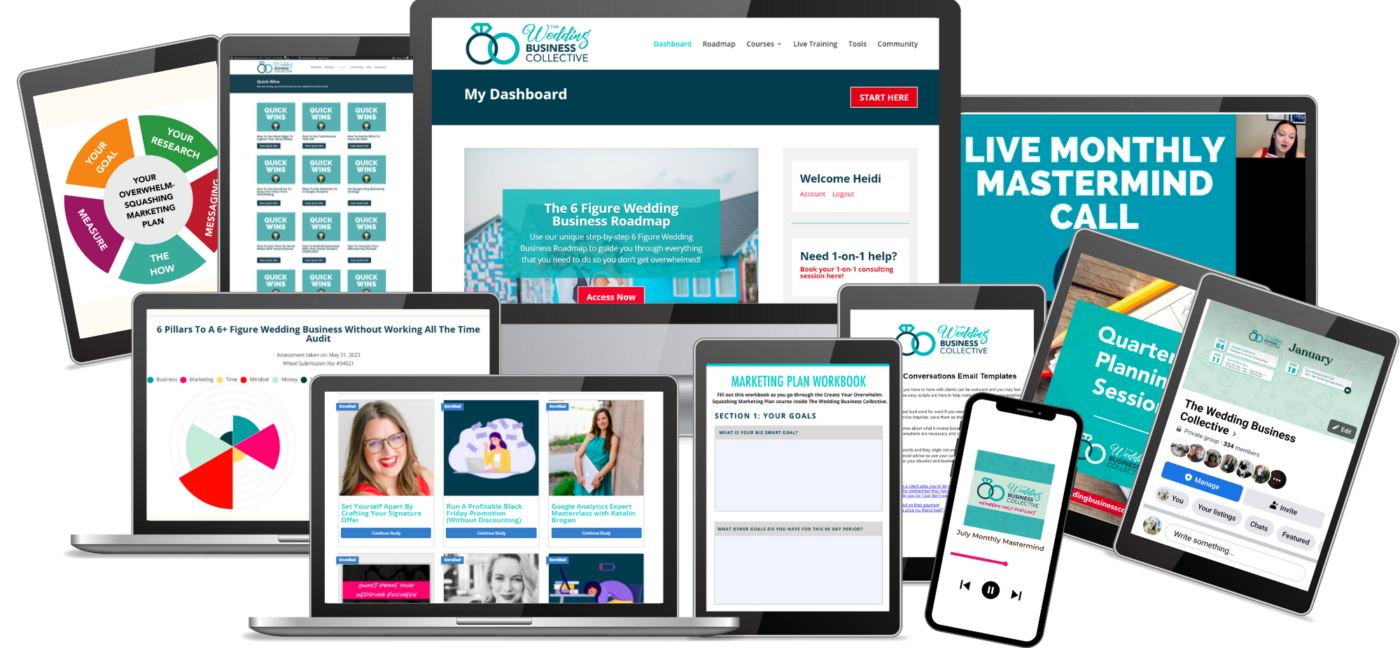
The Wedding Business Collective makes your marketing easier and takes less time than you ever thought possible.
You’ll get instant access to a simple roadmap to book more ideal clients and craft a business that gives you the income, life, and freedom you want. Sound like something you need?
How To Grow A Wedding Officiant Business By Standing Out
Hello, my friend. Welcome to the podcast. I am your host as always, Heidi Thompson, and I am here helping wedding professionals just like you all different types of wedding businesses all over the world build wedding businesses that give you the financial freedom, the time freedom, the creative freedom that you want, the freedom to have a damn life and take some time off, because who doesn’t want to do that?
Now, today I am going to take you behind the scenes of a business that I know and love. Very well because she is a member of The Wedding Business Collective. And I’ve gotten to see today’s guest, Mercy Ibarra, really grow and come into her own in her business and create a business that really positions her as the go-to. That is something we talk about a lot in The Wedding Business Collective, is really putting yourself in a category of one.
Yes, you you could compete with other planners, compete with other officiants, compete with other photographers, or you could do the much smarter thing of making yourself the go-to person for your specific ideal client, which is something that Marcy has done. And then it becomes an apples-to-oranges comparison. Could they hire a different officiant? Sure, but They don’t want to. They want Mercy because Mercy is the absolute go-to person for her ideal client.
And during this interview, we’re going to talk about her journey, how she got started, what’s working for her, what she’s doing with her marketing, what things haven’t worked for her, and how she has managed to build this business that is attracting her ideal clients reliably. And how she is balancing it with her job as a flamenco dance teacher in high schools and elementary schools in LA, as well as having an autoimmune disorder. So there’s a lot to juggle there, and I imagine that sounds a lot like your life as well. So if it does, you are going to get a ton out of this.
Let’s go behind the scenes with Mercy. Today I am joined by Reverend Mercy, who is a bilingual Latina interspiritual minister based in LA and member of the Wedding Business Collective. I am so excited to have you here, Mercy, because I know your business has grown and changed so much. So welcome and thank you for joining me.
Mercedes Ibarra:
Thank you, Heidi, for having me. This is going to be fun. I, uh, I’ve been listening to your podcast since before we met, so I’m very excited.
Heidi Thompson:
Oh, I’m glad to hear that. So tell me about your business, what it is, who it’s for.
Mercedes Ibarra:
Okay, so again, I’m Reverend Mercy, um, you can call me Mercy, and I am an interspiritual minister, which means I was ordained at an interfaith seminary, specifically it was One Spirit Interfaith based in New York. I did 2 years of training there. The first year was learning about the world’s major religions and, and doing some independent study as well. And then the second year was all about crafting ceremony for all of life’s major milestones. So that includes weddings, baby blessings, funerals, etc. And I am an officiant. I started officiating weddings back in 2016. My first wedding was for my friend Zeke, and eventually that has grown to now my main clients are Latino and Latina, Latinx— I use all the terms— clients who are looking for a spiritual but not necessarily religious ceremony, but one that still balances some respect towards their family’s traditions. Usually their families are either Catholic or Christian and are not very happy about the fact that they’re getting married outside of the church. So I find a way to create something that really honors the couple’s spirituality while still respecting the family’s expectations and traditions. And everyone leaves happy.
Heidi Thompson:
That is a delicate balance.
Mercedes Ibarra:
Yes, very much so.
Heidi Thompson:
I love that you’re able to provide that for people. And so you said like, you know, you studied this. You studied, you know, for 2 years in the seminary. But how did you decide to get started going down this path?
Mercedes Ibarra:
So, you know, when I went to seminary, I actually had a totally different vision for why I was going. I was volunteering in hospice, and I thought I was going to do end-of-life work. I wanted to be a death doula, and I actually still plan to do that training. But when I was graduating from seminary back in 2016, I hadn’t really told anyone I was even in seminary, and so I made a big Facebook announcement right before my graduation saying, “This is what’s going on. I’m getting ordained. I’ll be graduating this weekend.” And to my surprise, it was a hugely popular post. I didn’t really know how people were gonna react to it. And then when I arrived in New York the weekend of my ordination, As soon as I got to the facility where we were staying at, I got a Messenger app notification telling me that my friend Zeke had written me, and in that message he told me that he was getting married, that he and his then fiancée, now wife, Amanda, could not find an officiant. They were going to get married in South Carolina. They could not find someone who spoke Spanish. Spanish and understood their spirituality because they weren’t particularly religious. They were more interested in nature, and she’s a yoga teacher as well. So their spirituality had a lot more to do with what they did when they went camping or to the beach and her yoga practice. And the only people they could find in South Carolina who spoke Spanish were very, very much like maybe like Pentecostal, like very Christian, very
Mercedes Ibarra:
very in their church and not really a match for them. And so they asked me if I’d be willing to do it. The other thing is my friend Zeke is Dominican and I’m Cuban, so he knew that I would completely understand his family and what they were expecting from a wedding. And so they thought I’d be the perfect person to marry them. I decided to take a chance and do it, and I fell in love with the process ever since.
Heidi Thompson:
I love so much when we have these things that we stumble into, but you would have never thought that you would be doing weddings, like you said. And so you did that one and you’re like, hang on, this is fun.
Mercedes Ibarra:
Yeah, it was definitely fun.
Mercedes Ibarra:
And it’s very funny that I had to be surprised by, oh, the joyous occasion is going to be fun when I was very much headed in the complete opposite direction doing funerals.
Heidi Thompson:
That’s a very good point. That’s like a literal 180.
Mercedes Ibarra:
Yeah.
Heidi Thompson:
Huh. So how did you expand beyond that first wedding working with Zeke, and how have you marketed what you’re offering?
Mercedes Ibarra:
So my first foray into marketing outside of just talking to my friends was actually WeddingWire. I had a friend who was also an interspiritual who had— I had been friends with before. I kind of had followed in her footsteps. She was the person I asked about— I asked when I was considering seminary, like, what she had done. And so I asked her, well, how do you get work? And she was like, well, I’m going to a WeddingWire conference in January. Come with me. And so I went and I signed up then, and that’s actually how I got my first clients.
Mercedes Ibarra:
A lovely couple who hired me, uh, for my first wedding in 2017, uh, in November.
Mercedes Ibarra:
And, and that’s how it all started. I— the ball got rolling then. There was the wedding planner who found me after that.
Mercedes Ibarra:
She also found me on WeddingWire and asked me if I’d be willing to do the bilingual weddings for her because she had a whole business doing wedding on the beach. Um, and so I agreed to it at the time, and I started getting business that way as well. Um, and then eventually I also joined The Knot, um, as soon as I started making more money. Uh, and I, uh, and I kind of haven’t looked back from that.
Mercedes Ibarra:
What’s interesting is they’re still my main way of marketing, but As my prices have increased, The Knot has become the more predictable source of leads than WeddingWire. And when I first joined The Knot and WeddingWire, I can’t remember who the person was, my contact person at the time told me that as my prices would increase, I would get more leads from The Knot.
Mercedes Ibarra:
And that has turned out to be true.
Heidi Thompson:
That is really interesting. And I’ll just give like one sec here because there’s a little bit of rustling.
Mercedes Ibarra:
Okay, we’re good.
Heidi Thompson:
That’s really interesting that you noticed that as you had that price increase that you started shifting more toward the not. And I think to what you said about, you know, that planner finding you and wanting to work with you. I think that says a lot about positioning yourself as someone that can provide a unique expertise, a unique skill set to a specific community that, you know, not everyone has the ability to serve. And it clearly has gotten you sought out.
Mercedes Ibarra:
Yeah. And that was what was really surprising to me. We live in Southern California and As soon as I came into the picture, I was told by several people that there actually weren’t that many of us who were Spanish-speaking officiants, which surprised me.
Mercedes Ibarra:
It really surprised me.
Mercedes Ibarra:
And then on top of that, Spanish-speaking and with my training, I think I’m the only one so far. My friend who was here who also had the same training is trilingual. She also speaks French, but she actually moved back to Atlanta.
Mercedes Ibarra:
Um, she had been here from Atlanta for a while and moved back. So yeah, in terms of our specific training, I think I’m the only one right now. Um, and my marketing has changed a lot since then. Uh, I started, I first, I got into the Fellowship for Change through WeddingPro.
Mercedes Ibarra:
Uh, I applied for it the first year they had it, uh, which was during the pandemic.
Mercedes Ibarra:
And I got in, and I was immediately assigned a mentor who I absolutely love, Alaya Harris.
Mercedes Ibarra:
She worked with me and really helped me by defining my brand story.
Mercedes Ibarra:
We actually used that brand story book, and we came up with what my brand was, which is what I mentioned before, being, you know, the inner spiritual minister who serves the Latino community who is spiritual but not religious, but still wants to create a ceremony that not only they will, but their families will love. And that has been my main message, and I’ve actually been getting a lot more clients with that message that really match that expectation. Usually when they email me, that’s what they tell me.
Mercedes Ibarra:
They, they’re telling me, oh, I didn’t want to get married in the church, my family’s kind of upset about it, they finally accepted we’re not doing it, but we’re looking looking for someone who really gets us, uh, who wants to do these certain elements in our ceremony but still find a way for our parents to love it.
Mercedes Ibarra:
Like, it’s like they’re reading my marketing message to me verbatim when they’re writing an email to me. And that’s been amazing.
Heidi Thompson:
That is so awesome because, I mean, you know, this is something we talk about in the Wedding Business Collective a lot. Like, you want to be the go-to person for somebody, but it doesn’t matter if you know, that’s only in your head. If it’s not in any of your marketing, if you’re not putting yourself out there as, hey, this is who I am, this is what I do, this is who I do it for, those people can’t find you and they can’t, you know, want to work with you above someone else.
Mercedes Ibarra:
Yeah, no, exactly.
Mercedes Ibarra:
And, and I, I love it when that person finds me because their reaction is like, I don’t know, it just makes me feel like I really am serving some, a need that is out there because because they, they act like they’re like, oh my God, I, I didn’t even know you were out there. You’re, you’re the one I want, you know? And it’s like not even a question for them.
Heidi Thompson:
And that’s awesome. That is such a good position to be in.
Mercedes Ibarra:
Yes, it feels great.
Heidi Thompson:
What is a marketing tactic that has worked really well for you?
Mercedes Ibarra:
Because I know you’ve tried all sorts of things, so I think really what the work I did with Alea, um, on that brand story, like coming up with my brand script and using that to then design my website, uh, and then changing all my marketing based on that brand story. So like my WeddingWire page, my Knot page, all of that marketing has kind of shifted a bit to match the website.
Mercedes Ibarra:
That has been the number one game changer for me getting ideal clients that I really love. So I really highly recommend, if you haven’t heard of Brand Story, if you haven’t tried writing a brand script and finding your exact, uh, you know, message and who exactly you serve, that would be the first thing that I recommend anyone to do.
Heidi Thompson:
I know exactly what you’re talking about. I’ll link to the book in the show notes. I know Aleah is certified by them for all the StoryBrand stuff, and it It is just awesome to see, like, what a difference it makes
Heidi Thompson:
when you can base your brand around your ideal client in a way that they see themselves in it. And I think that’s really what your people are seeing. Like, that’s why they’re repeating it back to you.
Mercedes Ibarra:
That’s why they’re getting excited is because they’re like, yeah, I mean, she’s the one for me. Everybody else is just kind of an option, but, you know, she’s the perfect choice for me.
Mercedes Ibarra:
Yeah, and it’s made it great in terms of business for me because not only are they finding me, but I’m enjoying who I work with as well because it’s exactly who I want to serve. That’s what I love about it, is like you find your people and they find you.
Mercedes Ibarra:
Oh, I love that so much. You’ve got that perfect magnet of just attracting your ideal clients. So with that, I mean, we know some things that have worked for you. Wedding Wire worked, The Knot worked, getting referrals that planner, you know, working on the brand story. But what’s a marketing tactic that just totally bombed for you?
Mercedes Ibarra:
So I feel like I’m still in the experimental phase, and I may try this again, but the one thing that totally bombed for me in the last couple of years was actually doing one of the bridal shows.
Mercedes Ibarra:
Okay.
Mercedes Ibarra:
Yeah, like, I put a lot of money into it. I got a big beautiful banner made. I had materials made. Um, I got a good little spot. But I— for one, it was smaller than it was supposed to be because we were still at the tail end of the, you know, pandemic. Um, not that we’re not out of it, but you know what I mean. It was when things were first opening up, and so that could have been part of the problem. Um, but I met a lot of people that day. It felt pretty exciting, but then I only ended up getting like, um, 2 really good leads out of it, uh, and one of the leads, uh, was emailing back and forth with me but then eventually just ghosted me, and I’m not sure what happened there. Uh, and then another one actually made an appointment to speak with me face to face, but it became very clear that she actually wasn’t, uh, my ideal client. For one, she was kind of kicking tires and looking for a lower price. And but second, like, I’m not exactly sure why she wanted to meet with me because it sounded almost like she was on the road to getting baptized in her mother-in-law’s Pentecostal church. And I was like, well, not sure that’s gonna work. I’m not sure you’re gonna like what I do for you. And I’m certainly sure she’s not gonna like what I do for you. So it was just a little odd. I think they weren’t yet clear on what they wanted.
Mercedes Ibarra:
That’s really interesting.
Heidi Thompson:
Is it something that you’ll test again?
Mercedes Ibarra:
I’m thinking of testing it again. I really wanted to test it again this last March because it’s springtime, it’s the beginning or right before wedding season, and I thought it would be a better time. But I’m also a high school dance teacher and this was the first year back and our annual show is in April. And so there was just no way that I could invest any time in that. So I might try it again in the fall. Um, so just to give it a real chance. The other thing that I didn’t do is I didn’t follow up on emailing the email list that they give you. Um, and so I feel like I didn’t really give it a chance until I do that.
Heidi Thompson:
I like the way that you’re dissecting that because a lot of people will try something and just be like, nope, didn’t work. But you’re getting curious about why. And I think that is one of the most valuable skills that you can develop because sometimes you’re like 95% of the way there and just by asking why and changing one or two things, you know, you can make something work for you that previously didn’t.
Mercedes Ibarra:
Yeah. And that’s the way I was thinking about it too. My sister-in-law went to work the booth with me that day and one thing that she pointed out was that she thought that some people were getting hung up on the word bilingual and for some reason jumping to the conclusion that, oh, she’s for people who speak Spanish, and not really thinking about the fact that, well, bilingual means I also speak English, so I could do your ceremony in English. So she thought that next time I go, that I try and highlight the inner spiritual thing more, like have a more obvious, you know, thing like symbolism on my table with all the like different interface symbols and stuff and see if even just that little tweak makes a difference with who comes to the table. And I thought that was an interesting idea, so I might try that as well.
Heidi Thompson:
You know, it could be to changing bilingual to English and Spanish.
Mercedes Ibarra:
Yeah, people are just getting like hung up on like, well, I’m not bilingual, so Yeah, but I did think that was an interesting point because it was kind of like the people who were like, oh, coming over to me were the ones that were with their mom, and it was obvious they were speaking Spanish to each other.
Mercedes Ibarra:
Oh, okay.
Mercedes Ibarra:
And others that were kind of like looking at me slightly interested, but then like me having to work to get them to come over and talk, it did seem like they were getting hung up on the language thing.
Heidi Thompson:
That’s interesting. Yeah, that’s so weird. I love the little things you find out as you go through marketing experiments and you test things and it’s just like, okay, I did not anticipate that, but we’ll deal with it.
Mercedes Ibarra:
We’ll change things.
Heidi Thompson:
So you mentioned you are also a high school dance teacher. What does that mean for managing your time between dance, between your business, between, I don’t know, having a life?
Mercedes Ibarra:
It is difficult, I will tell you that much. I, like I said, I did a lot of building of my business during the pandemic, so I had the luxury of time, right? I was still teaching my students, but it was teaching from home. It wasn’t really— we didn’t have our big showcase, for example. We didn’t have any performances. I personally didn’t have any performances because I still perform as well. And so there was all this extra time, and this year like getting back to everything was like a bit shocking. I had forgotten how time-consuming it all was. Um, so I’m still trying to figure out balancing everything out. I have like my days, right? So I teach at the high school on Wednesdays and Thursdays, so I kind of just block out Wednesday and Thursday as dance day. Sometimes I try to fit other stuff in, but Really, Wednesday and Thursday, the main focus is, you know, anything having to do with the high school. I also teach workshops at elementary schools on the other days, but given that those classes are, you know, not as intense, it’s usually third graders, they’re getting just a base level introduction to my dance form, which is flamenco, and the history behind it. Those lessons are already planned out. Like, I’m not teaching anything that is like super, you know, intense. So I can, during my breaks, I can squeeze in time for work on my business. And then there is usually one day a week where I don’t have any teaching that I do, and that is definitely a day dedicated to my business. But it is hard because I also have an autoimmune disease. I have lupus. And there are days where I wake up feeling like a truck hit me and then I’m like, well, what am I supposed to do now? So it’s kind of hard because I also have to factor in downtime and time to just like lie in bed or even on the couch and then figuring out if I have enough energy to maybe pull out the computer and do something on those days.
Heidi Thompson:
I’m curious how you manage that because A lot of people are in that position, and I feel like it’s this
Heidi Thompson:
continuum of just absolutely beating the shit out of yourself for having limitations and just like being totally cool with it. And people kind of fall somewhere in there and it kind of moves around from time to time.
Mercedes Ibarra:
And that’s the truth for me as well.
Mercedes Ibarra:
There are days where I’m like, I’m being so lazy, I have to do something. I can’t believe I did nothing. But then I’ll wake up the next day and feel totally fine and I’m like, oh yeah, I was really sick yesterday. Yeah.
Mercedes Ibarra:
So I was right not to do anything. So it’s like this constant having to remind myself that yes, I, I am feeling fatigued.
Mercedes Ibarra:
I’m not making it up.
Mercedes Ibarra:
It’s not me being lazy. And I have to just make peace with, okay, well, if I’m feeling like that today, I know that if I push too hard today, it’s only going to be worse tomorrow. So I need to just like let myself have that rest.
Mercedes Ibarra:
And usually what happens is I pretend I’m gonna be watching TV or something and I just fall asleep.
Mercedes Ibarra:
And so I’ll just sleep for however long I need I sleep and then maybe I feel better later in the day and I can do something. That’s often what happens.
Heidi Thompson:
It’s a good way of handling it. Just, nope, going back to bed, sleep it off. Yeah.
Mercedes Ibarra:
Yeah. And then I also have a meditation practice and that honestly has helped a lot because it does make me conscious of my thought patterns. It makes me aware of how my body is actually feeling. And so I’m able to be a lot more mindful about, you know, what my limitations are that day.
Heidi Thompson:
That’s really good that you’re able to give yourself that grace because I know that’s something we all struggle with. Like, when you are unable to do something for whatever reason, it’s so easy to come down on yourself and just, like, destroy the rest of your week over it, as opposed to just being like, “Okay, we’re moving this, we’re shifting this. This is just life. This is how we have to work.” Yeah. So I mean, overall, how would you say your business has changed over time?
Mercedes Ibarra:
Um, well, for one, I really feel like it’s gaining momentum. Like there, you know, I have like some followers I’ve noticed on Instagram, for example, that I think are like potential couples now. Like I’m finally seeing that, like I feel like My business has grown enough where I’m starting to get people checking me out in an obvious way before they come and actually, you know, metaphorically knock on the door.
Mercedes Ibarra:
I feel like I’ve gotten to know a lot of people in the industry, and I’ve been learning a lot by things like the Wedding Business Collective. Like, having joined has been great.
Mercedes Ibarra:
I plan to spend a lot more time this summer dedicating more time to like looking around the website, ’cause I haven’t had time to do that this school year, again, ’cause I was in shock by how busy it was. But I just feel like my, there’s momentum in my business.
Mercedes Ibarra:
When I first started, it was kinda like, oh, this is really, you know, new. Are people really gonna wanna pay for this? I was charging too little. Now I’m charging more than twice as much from when I started.
Mercedes Ibarra:
And so now like, my taxes at the end of last year, like I had to pay more taxes, but it was because I made more income and it actually started to look like it was, you know, becoming something more reasonable.
Mercedes Ibarra:
It wasn’t just like a side hobby kind of job. It now feels like it’s like, you know, my real business that’s happening. So I feel really like I’m gaining confidence and I feel like that’s showing as well.
Heidi Thompson:
That’s huge, that confidence. And like, just knowing that you have that momentum, it’s so much more encouraging to be able to like get up in the morning and like run with it, as opposed to when you’re in a position and it feels like you can’t seem to make anything work.
Mercedes Ibarra:
Exactly.
Heidi Thompson:
What about the services that you offer? Have those changed over time?
Mercedes Ibarra:
So the way I think about them has changed. Like, before I used to like do, you know, just a ceremony and then like maybe the rehearsal would be something added on. Like now I have my packages set up where like the main service I provide is a ceremony and rehearsal and people kind of have to ask me if I can do it without the rehearsal. Like I just kind of make the rehearsal part of the package.
Mercedes Ibarra:
And so I’ll still offer a ceremony alone if people really don’t want a rehearsal, but I’ve actually made it more part of the package just because I think people are more comfortable once they’ve had a rehearsal. And I don’t rehearse everything verbatim. I don’t think anybody really does. There’s a special magic to the ceremony being done fresh the day of. But I do think that You know, it just feels better for everyone involved, especially if you have a big wedding party, to have the rehearsal included and everybody knows what they’re doing, what to expect. I think it makes the couple feel more secure knowing that I’ve been to the site and they, I, they can see me in action, see that I know what I’m doing.
Mercedes Ibarra:
And, um, and then I have also included other packages.
Mercedes Ibarra:
This is also something Alea helped me with. I have packages that include the premarital counseling, and there’s levels of premarital counseling. So that has changed as well. I used to offer that as its own little independent thing as well and let people ask for it, but now I’ve built it into a package that you can get, or two different packages you can get. One which is just one session of premarital counseling, and then I have another package that’s like the big bonus package that has several sessions of premarital counseling that go through different subjects that, such as, you know, finances, uh, dealing with each other’s families, things like that. Um, so that’s what’s new.
Mercedes Ibarra:
And then I’m also still offering baby blessings.
Mercedes Ibarra:
I’ve done a few funerals, so I don’t just have the wedding services. It’s just the wedding services are the main part of my business.
Heidi Thompson:
I think the psychology of how you structure those packages is really smart because there’s a difference between seeing a bunch of things and feeling like one of those is being taken away when you go for the lower package versus I’m going to have this and I’m going to add this on. Then it feels more like, do I need that? Do I really need the add-on? We just question it way more than if it just all comes as one package. So much that happens with that. Like, okay, it, you know, it all comes together for a reason. Yes, I want all this now. I feel like I’m connected to it. I don’t want any of it to be taken out because I want all of it. So I think that’s really smart, the way that you structured that.
Mercedes Ibarra:
Yeah.
Mercedes Ibarra:
And one thing I’d say too that I’ve discovered in doing that is when a couple asks for even just one premarital counseling session ahead of time, It actually lends to an even, uh, an even better ceremony because it’s like I’ve spent even more time with them. I’ve gotten to know them even better than our initial meeting because we do have our planning meeting, which is a couple hours long.
Mercedes Ibarra:
I ask them a lot of questions to get to know them in order to design a custom-made ceremony.
Mercedes Ibarra:
But when I also have the counseling session with them and we get into these deeper dynamics of their relationship, it’s not that I talk about those dynamics, that’s their own private matter, but something about knowing that work that they’re putting into it lends itself to adding more depth to the ceremony in some way.
Mercedes Ibarra:
So I just think, I think it’s a really nice thing if a couple asks for it. I think it really does help get their mindset on, okay, this is what marriage is going to be about, it’s not just this party, but it also makes the ceremony itself
Mercedes Ibarra:
more special.
Heidi Thompson:
That’s so cool. Like, what an interesting byproduct from that.
Mercedes Ibarra:
Mm-hmm.
Heidi Thompson:
So with everything you’ve been doing over the years, I’m sure you’ve come up against challenges, COVID being one of many, I’m sure. But what’s maybe one challenge that you faced while trying to grow your business?
Mercedes Ibarra:
Well, definitely the time issue in terms of time and energy management, right? In terms of my illness, that’s been the biggest challenge, um, is just keep taking care of my health while trying to do all the things I want to do, um, to make things happen. And I think I’m just slowly working on that. I, I do little things every day, but yeah, being able to be productive while still taking care of myself, I think is the biggest challenge. And then another challenge with working with my business, I think is the challenge of like people not really knowing what else I do. Like the wedding business is actually very obvious and it’s definitely the funnest part of my job, right? But I do have a challenge of letting people know, hey, like, if planning to have a kid, you’re spiritual but not religious, you don’t want to have your child baptized in the church, you have options. Like, so there’s that. It’s trying to get the word out there as well that there’s other milestones that you can celebrate in this really special and sacred way, and that I’m, I’m somebody trained to do that and to help you figure that out.
Heidi Thompson:
Yeah, I’m sure a lot of people don’t even have like the life experience of seeing something like that to know that it’s even a possibility.
Mercedes Ibarra:
Yeah, it’s still pretty new. Like, I, I was actually surprised when people found me. It turns out they were finding me because they Googled baby blessing, non-religious baby blessing, and I guess my seminary’s directory came up. So that’s great. I’m glad to know that’s working. But yeah, I, I’ve, I have to think about ways of getting that out there as well. And honestly, I’ve done 4 funerals, and even though they’re sad occasions, I’ve actually loved every minute of doing those as well. My funerals aren’t necessarily— they’re more like what we call life celebrations. It’s trying to really celebrate the person’s life and finding a new way of doing it. So I got to work on figuring out how to get people to realize that there’s more that this inner spiritual minister can do for you in terms of any kind of ritual celebration you might want.
Heidi Thompson:
That’s an exciting position to be in though, because you’ve got the marketing down for the weddings and that’s just like churning in the background. And now you can shift your focus to these other areas and get those up and running as well. And I think just having that foundation of, you know, you have people finding you reliably, it allows you to be able to just like take a deep breath and we’re gonna work on something else.
Mercedes Ibarra:
Yeah.
Heidi Thompson:
So what’s one thing that you wish you knew when you were just starting out?
Mercedes Ibarra:
The one major thing I wish I knew when I was just starting out is that, is that whole concept of your story brand, right? Um, and knowing that there’s a client for everybody out there. So if you have a service that you know you believe in and you know will be a good service, but you just don’t know how you’re gonna like find people, just fine tune, well, who am I trying to serve? And that person will show up. There’s somebody for everybody. I’m not for everybody. Right? And not every client is for me, but obviously I have my people that want to work with me, and I have people that I want to work with, and it’s possible. So I think that that’s possible for everyone who wants to be in business.
Heidi Thompson:
And that’s exciting because I think a lot of times we feel like we have to just like fit the mold of what everybody else is doing. But when you realize like, no, I want to work with this particular type of person, you can become that go-to.
Mercedes Ibarra:
Yeah, exactly. And it’s just so much more fun that way.
Heidi Thompson:
Yeah, you get to hang out with the people that you actually like hanging out with.
Mercedes Ibarra:
Yeah, exactly.
Heidi Thompson:
So you talked about wanting to get the word out more about baby blessings and funerals, but what other goals do you have for, say, the next 12 months-ish?
Mercedes Ibarra:
So I am really toying with the idea of either starting a YouTube channel or starting a podcast or some combination of the two. So I’m hoping to get that going next year. The other thing I’ve been playing around with, and Alea, if you’re listening, I haven’t gotten on it yet and I’m sorry, but it’s Um, is, uh, because I know that premarital counseling sometimes costs more than people want to pay, but they are interested in doing something. So I’m thinking about putting together some kind of module-type training coaching, um, like premarital counseling coaching that could be like a lower tier, like a monthly membership that a couple might pay and they do things on their own. So that’s something I’m toying with.
Heidi Thompson:
Oh, those are exciting ideas. I can’t wait to see what you do with those.
Mercedes Ibarra:
Yeah, I can’t wait either.
Heidi Thompson:
Like, I have no idea how I’m gonna do this.
Mercedes Ibarra:
Can’t wait to see.
Heidi Thompson:
Well, Mercy, if people want to connect with you, if they have any questions for you, where should they go?
Mercedes Ibarra:
So my website is revmercy.com. That’s rev as in Reverend mercy.com. And I am also on Instagram at rev.mercy.ceremonies. And I’m also on TikTok under that name, but I’m not yet as active on TikTok. I guess that’s a goal too. I need to get more on TikTok, but I’m definitely very active on Instagram.
Heidi Thompson:
Awesome. I’ll be sure to link up to all that, and thank you so much for taking the time to pull the curtain back a little bit and show some behind the scenes in your business.
Mercedes Ibarra:
Well, thank you for having me. This has been a lot of fun.
Heidi Thompson:
I hope you learned a lot from this. I hope it gave you some inspiration, gave you some ideas. Definitely reach out to Mercy if it did and thank her for doing this. I love when members of the Wedding Business Collective agree to come on and talk about their business because because we don’t often hear so much about what goes on behind the scenes, and that’s really the kind of thing we need to be talking about more. I have linked to her website, her Instagram, over in the show notes at evolveyourweddingbusiness.com/249, and over there you can also come join us inside the Wedding Business Collective and learn how to make yourself the go-to person for your ideal client. If that’s something that you want to do, head over to theweddingbusinesscollective.com. Join us and get started. In your first month in the membership, you can get your entire marketing plan done so you know exactly what you need to do in order to bring those ideal clients to you. Thank you so much for taking the time to tune in today, and I will speak to you again. Very soon.